



Revision hair transplant
For people unhappy with an earlier transplant: a correction planned after assessing the existing grafts, the donor capacity and the hair exit angles.

How is a revision hair transplant planned?
Revision hair transplant is considered for people who did not get the result they wanted from an earlier hair transplant, or who have an unnatural hairline, uneven graft density or misplaced grafts.
At HED Health, revision operations are planned after a detailed analysis of the current transplant, the capacity of the donor area, the distribution of the grafts, the hair exit angles and the anatomy of the recipient area.
Each revision is handled individually, according to the person's current situation and needs, on the basis of scientific and anatomical assessment. The aim is to correct existing errors as far as possible, to improve the hairline and the distribution of density, and to achieve a more natural and balanced look.
Why is assessment the first step of a revision?
The most important decision in a revision is how many usable grafts are left in the donor area and how far they will go. The earlier transplant may have used the best follicles; those that remain may be fewer and weaker.
The result of the earlier transplant also needs to be clear, which usually happens at 9–12 months. Expectations are discussed openly at the examination: a revision can fully correct some problems and only make others less noticeable.
How is an unnatural hairline corrected?
Large grafts placed with older techniques can look clustered. A hairline that is too low, too straight or too round, and hairs placed at an angle different from their natural direction, are also among the issues a revision addresses.
If needed, these grafts are removed, divided into smaller grafts and placed again in more suitable areas. In front of them, a soft transition zone is created with single-hair grafts; placing the hairs in their natural direction conceals the old grafts. Any large grafts that remain become less noticeable this way.
What if the donor area is depleted?
Taking grafts outside the safe zone or too densely can leave the donor area looking thin. This limits the remaining donor capacity and directly shapes the plan.
When the scalp donor area is not enough, beard or body hair can be an option to cover a strip scar and fill in a thinned donor area. In some cases, scalp micropigmentation is a better route than a transplant.
When is micropigmentation considered instead of a transplant?
A wide strip scar or visible FUE dots can be made less noticeable with scalp micropigmentation (SMP). Micropigmentation is not surgery and needs no grafts from the donor area, which is why it comes to the fore when the donor area is depleted. More than one session may be needed.
Micropigmentation does not grow hair; it only gives the look of closely cropped hair. Which route suits you depends on where the scar is, how wide it is and the state of the donor area.

How is a revision plan put together?


- 1
The existing hairline
The hairline of the earlier transplant is assessed against your facial proportions, your age and the likely course of your hair loss.
- 2
Graft distribution
Areas where density is uneven, or where grafts look clustered or sparse, are identified.
- 3
Hair exit angles
The direction and angle at which hairs leave the skin are examined; areas that depart from the natural direction are marked.
- 4
Donor capacity
The part of the donor area already used and the grafts that can still be taken safely are calculated.
- 5
The new plan
If needed, old grafts are redistributed, and the hairline is finished with a soft transition of single-hair grafts.
Who is it for?

May be suitable
- An earlier hair transplant that did not give the result you wanted
- An unnatural hairline, uneven density or misplaced grafts
- An earlier result that is now clear (usually after 9–12 months)
- Usable grafts left in the donor area

May not be suitable
- An earlier transplant whose result is not yet clear
- A scarring hair condition, such as lichen planopilaris or frontal fibrosing alopecia, that has been active recently
- A depleted donor area where body hair is not suitable either (scalp micropigmentation is considered instead)
- Expectations that the remaining donor capacity cannot meet
Representative images
Your doctor decides whether it suits you after an examination.
Surgery day
Five steps in one day. The state of the earlier transplant and the donor area shapes the plan.
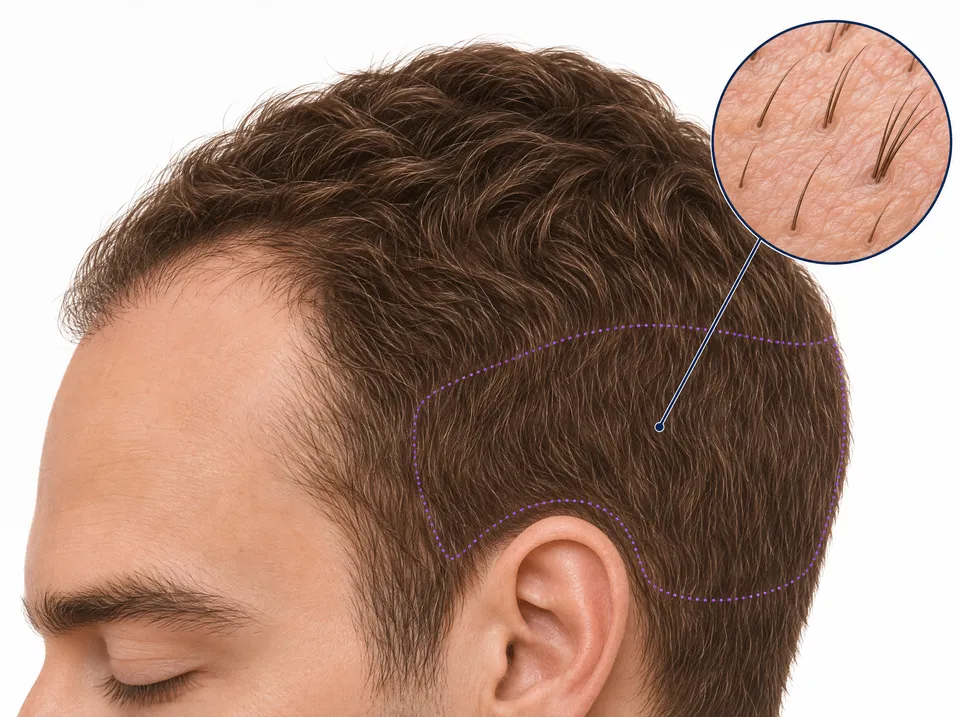 Step 1 · 45 min
Assessment
The current transplant, the remaining donor capacity, graft distribution and hair exit angles are examined. Your scalp is checked with a hair analysis device, and blood tests are done if needed.
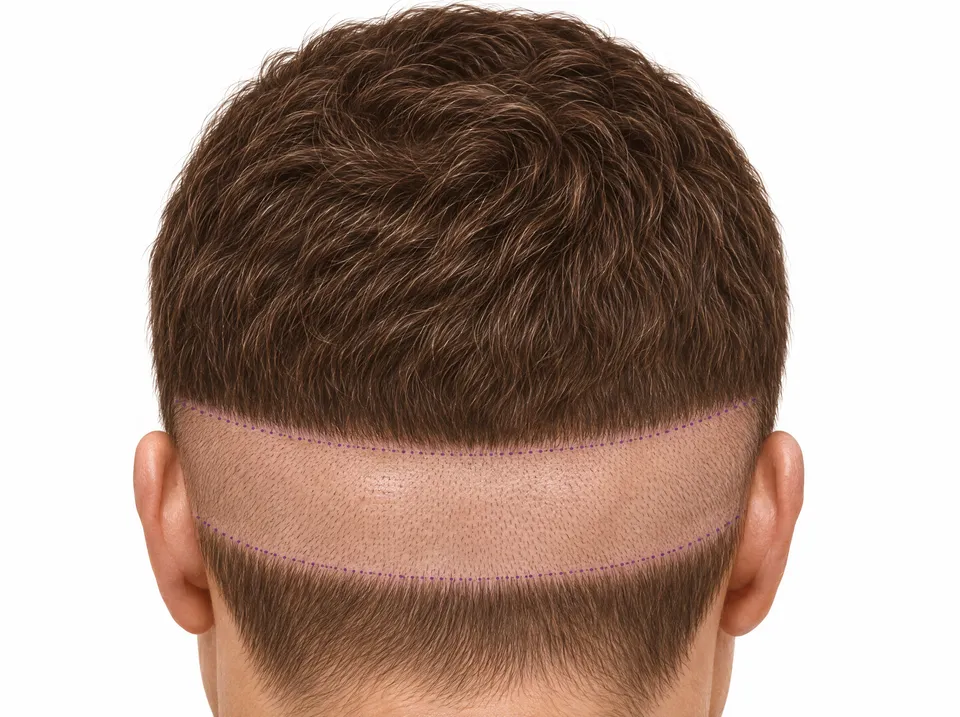 Step 2 · 20 min
Local anaesthesia
The donor and recipient areas are numbed; you stay awake throughout.
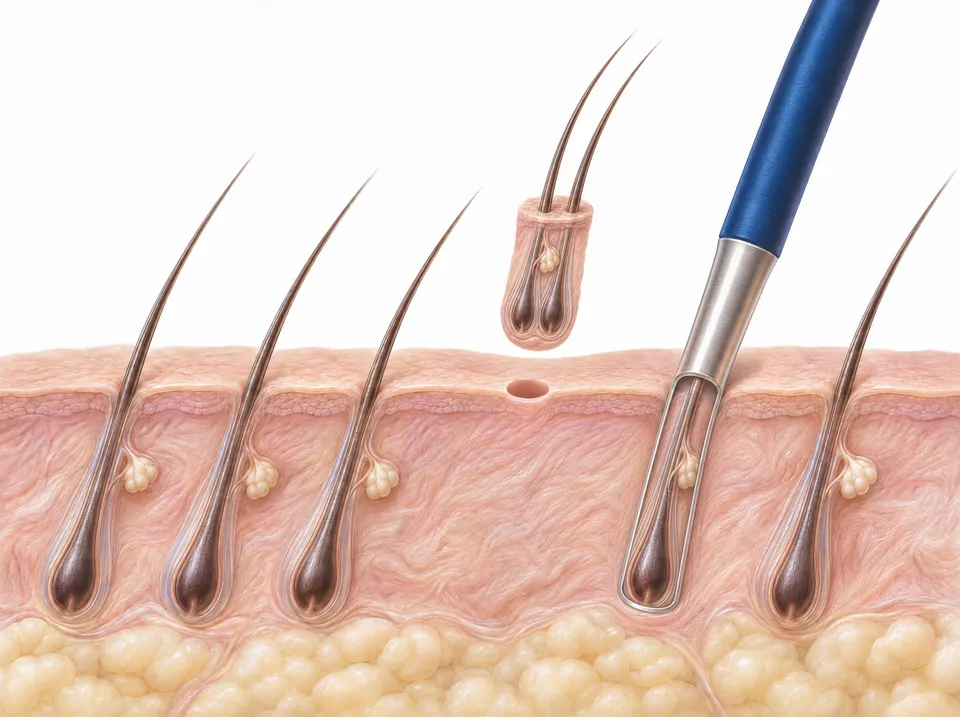 Step 3 · Depends on graft count
Extracting or redistributing grafts
If needed, badly placed large grafts are removed, divided into smaller grafts and reused; new grafts are extracted one by one from the donor area.
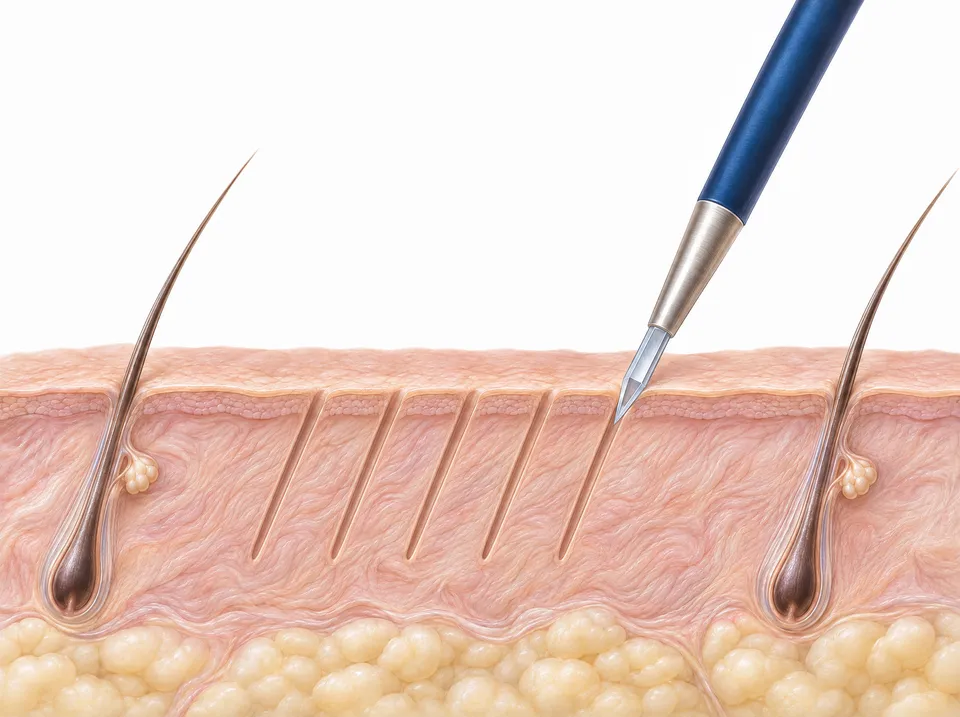 Step 4 · Depends on graft count
Placing grafts in their natural direction
Grafts are placed at their natural exit direction and angle; at the hairline, single-hair grafts create a soft transition.
 Step 5 · 30 min
Aftercare and discharge
A dressing is applied; you receive an aftercare kit and written instructions.


Representative images
The images are illustrations; no surgery photos are used.
Recovery timeline
- The first two weeks
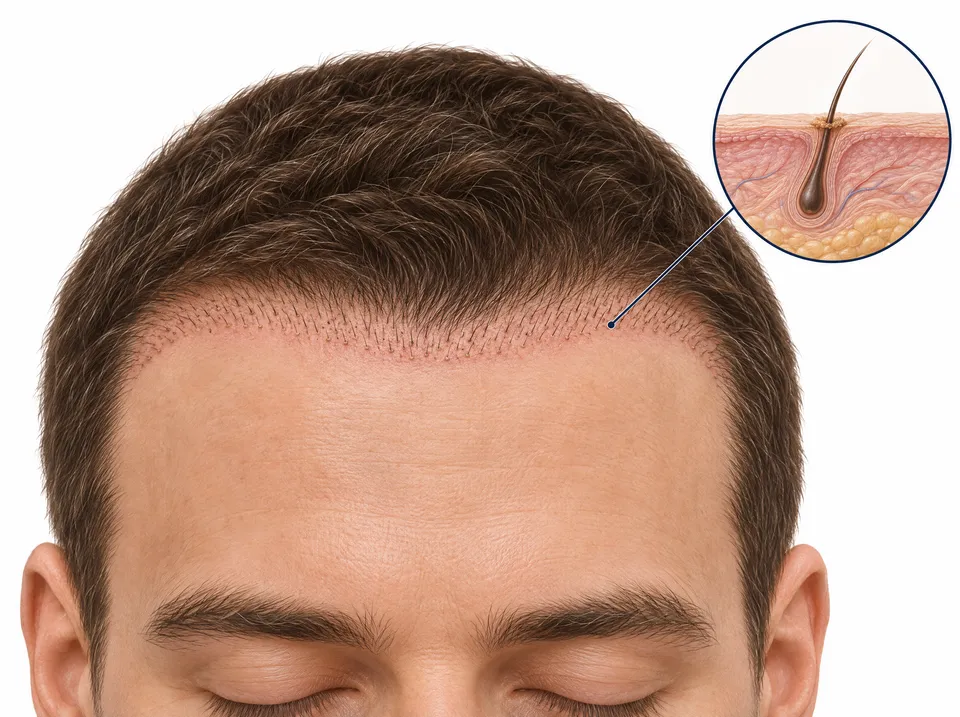
Surgery
You leave at the end of the day with written aftercare instructions.
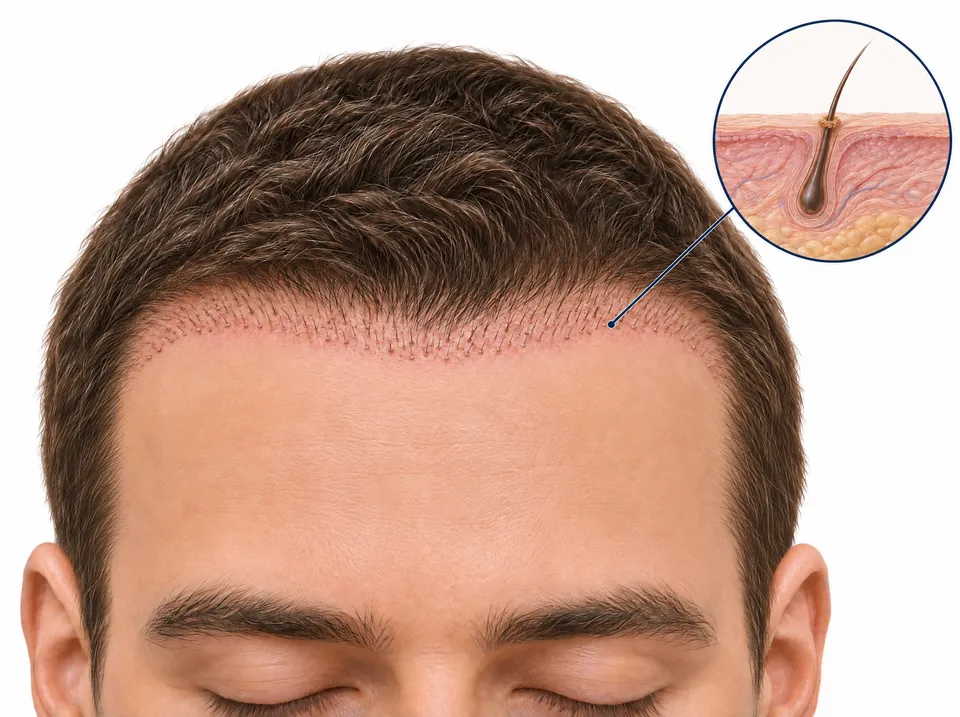
Dressing and check-up
The dressing comes off; the recipient and donor areas are checked.
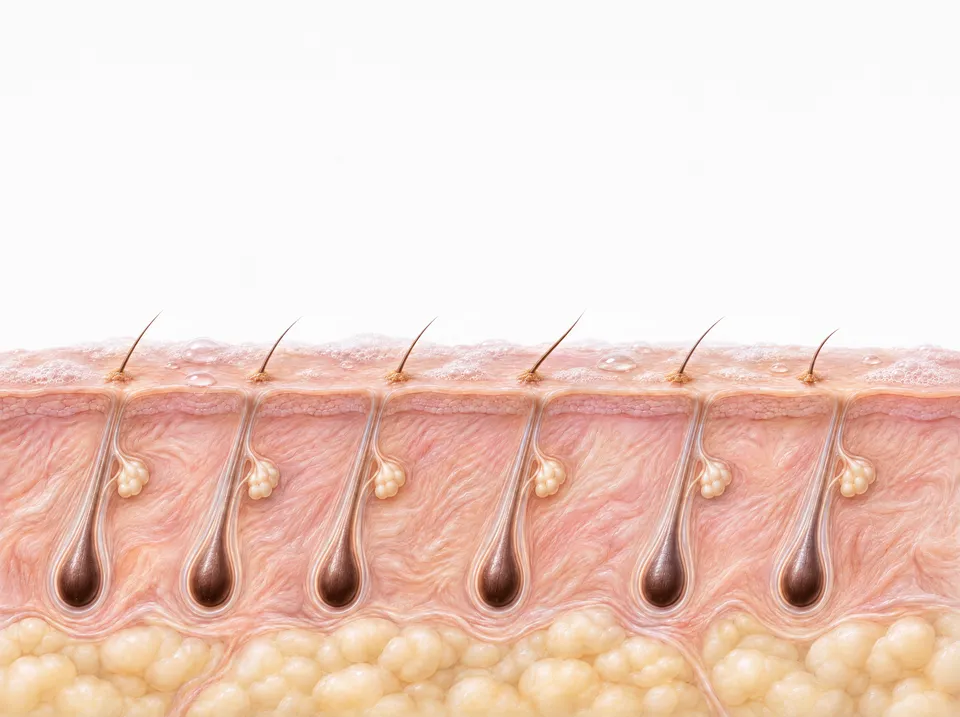
First wash
The first wash is done, and you are shown how to wash your hair at home.
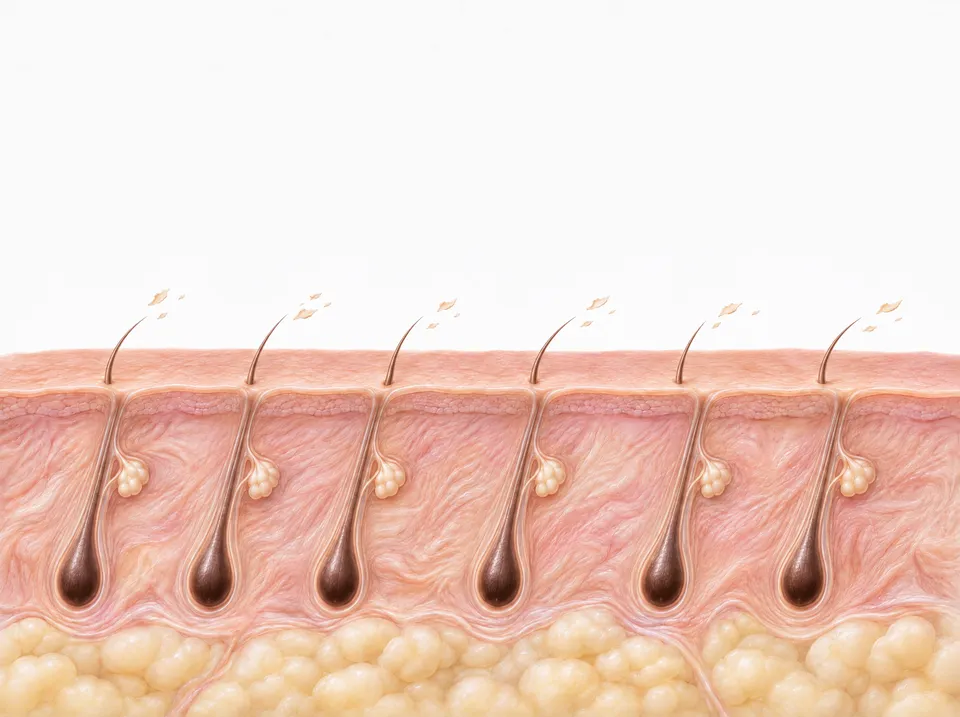
Scab wash
The scabs are washed off; redness starts to fade.
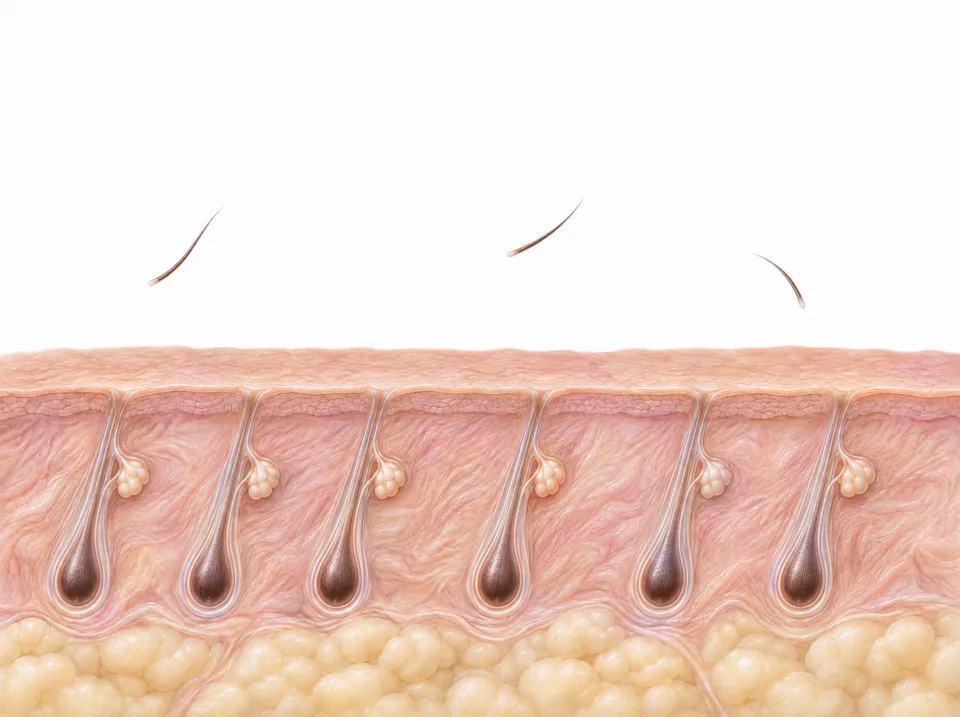
Shedding of transplanted hair
Some transplanted hairs may shed; the follicles stay under the skin.
- Over the months
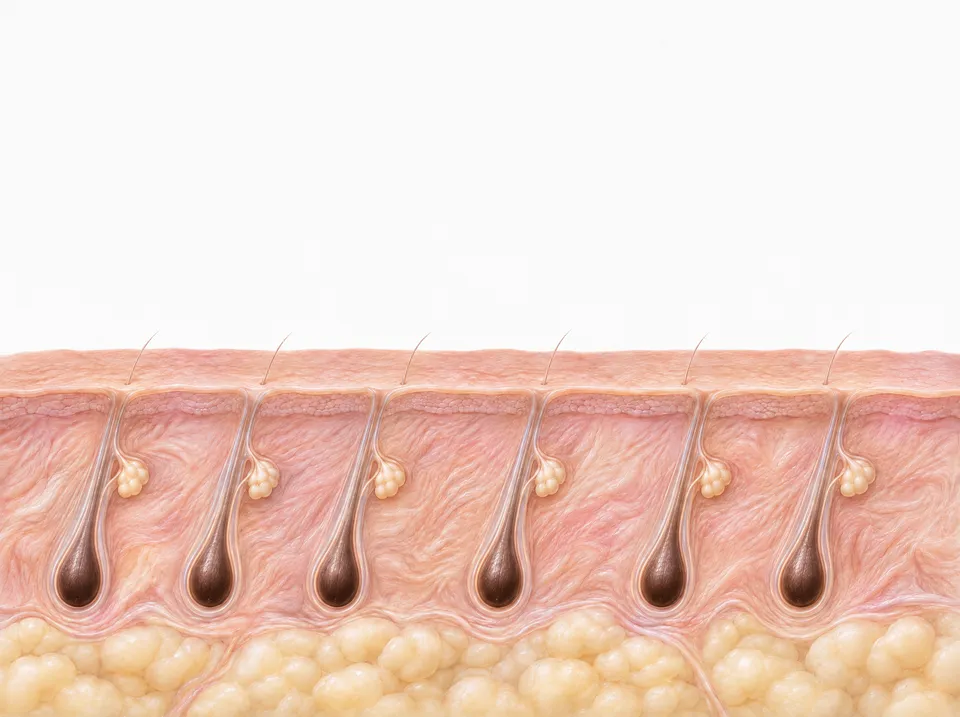
First growth
New hairs start to appear.
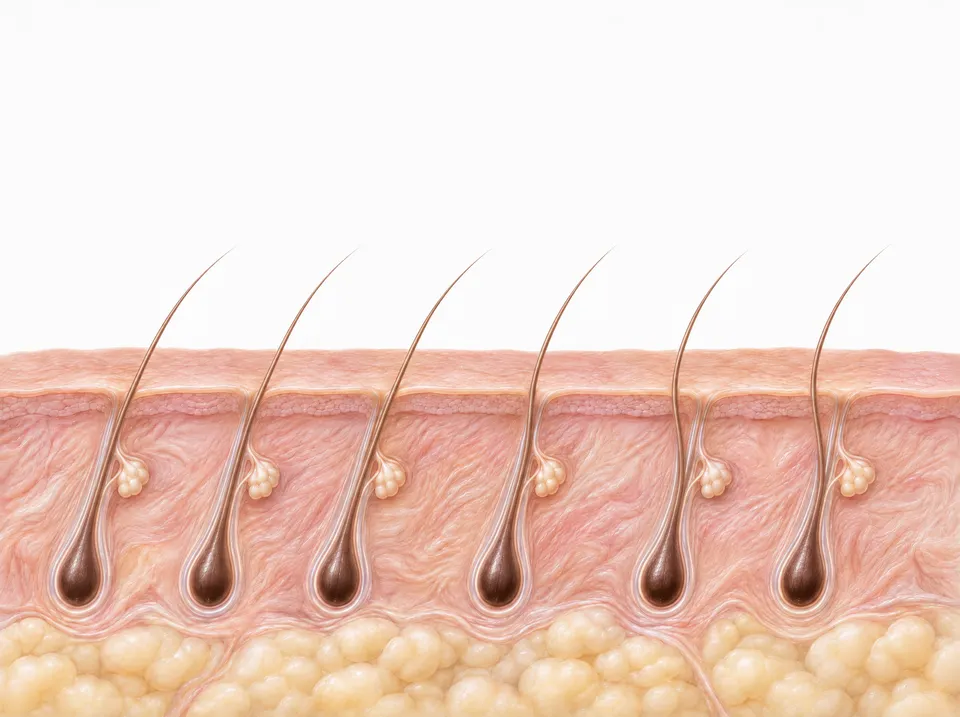
Visible growth
The hair grows longer; the new hairline starts to show.
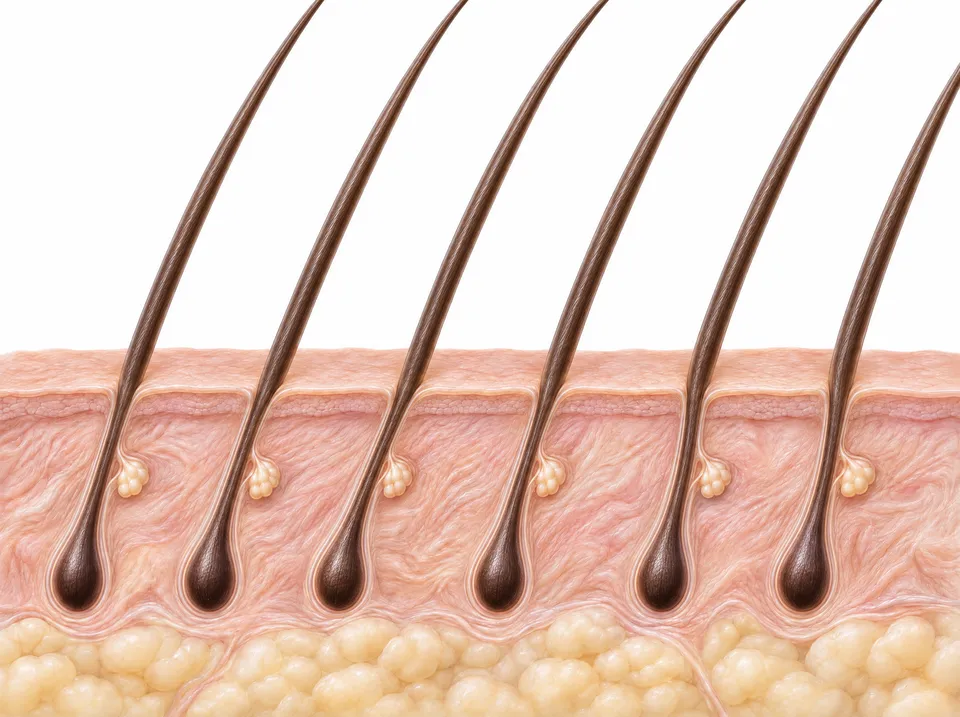
Density builds
Density increases. If needed, a further session is discussed after this period.
Final assessment
The result is assessed with photos taken at the same angle and in the same light; the next step is discussed if needed.


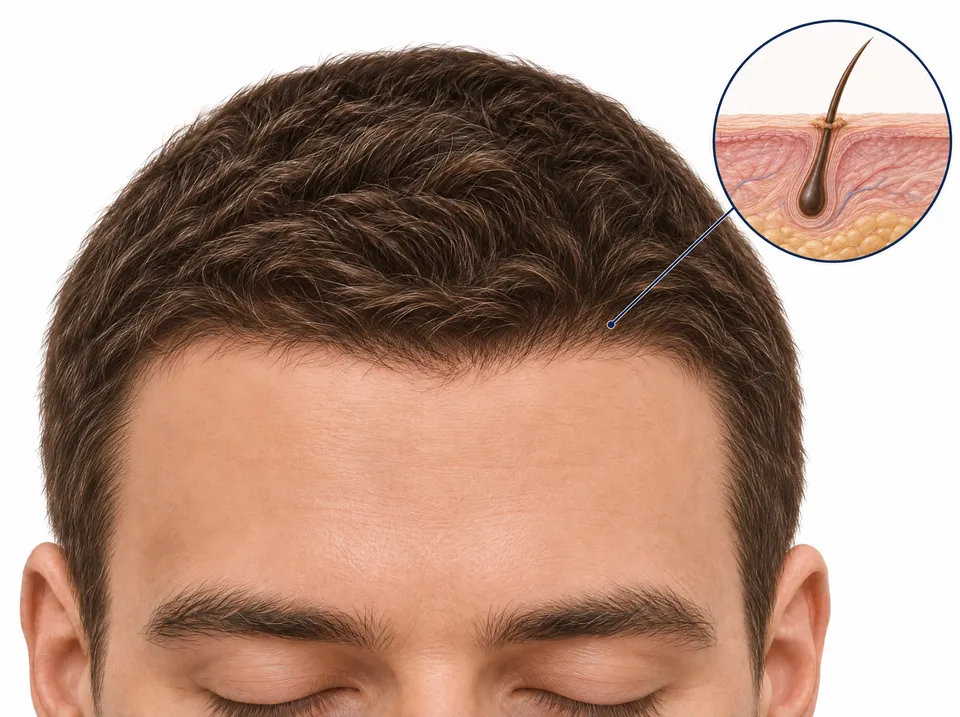
Timings are averages and vary from person to person. The drawings are schematic sections of the scalp.
Representative images
Risks and side effects
Every procedure carries risks. Most are temporary; your doctor goes through each one with you before surgery.
Further depletion of the donor area
A revision draws on a donor area that has already been used. Every graft is planned carefully, and the remaining capacity is weighed against procedures you may need later.
Some problems only become less visible
A revision can fully correct some problems and only make others less noticeable. This is discussed openly while planning.
Temporary shedding
Existing hair around the treated area may shed for a while; it usually grows back within a few months.
Small scars where grafts are removed
If large old grafts are removed, small scars may remain in their place; these are usually covered with new grafts or with scalp micropigmentation.
Swelling
It can affect the forehead and around the eyes and usually settles on its own within 5–7 days.
Infection
It is rare. If you have a fever, increasing redness or discharge, message us without delay.
Frequently asked questions
How long after my earlier transplant can a revision be done?
The result of an earlier transplant usually becomes clear at 9–12 months. The revision is planned once the result is clear and the donor area has healed; your doctor sets the timing after the examination.
Is a revision harder than a first transplant?
Often, yes. The donor area has been used before and there are old grafts in the recipient area, so a revision needs more planning and experience than a first transplant.
Can old grafts be removed?
Yes, when needed. Grafts that are badly placed or look large can be removed, divided into smaller grafts and placed again in a better spot. This softens the hairline without losing the hairs.
How many sessions are needed?
A revision often needs more than one session. The result of each session becomes clear at about 12 months; the next step is discussed based on that result and the remaining donor capacity.
How does scalp micropigmentation help in a revision?
Scalp micropigmentation can make scars in the donor area or thin areas less noticeable. Because it needs no grafts, it is considered alongside a transplant when donor capacity is limited.
What should I look for when choosing a clinic?
The ISHRS recommends asking who will assess your hair loss, who will do each step of the operation, and what their training, licence and experience are. Designing the hairline, extracting grafts and making the recipient sites are the responsibility of a licensed doctor.
References
- 1.Bernstein RM, Rassman WR, Rashid N, Shiell RC. The art of repair in surgical hair restoration part I: basic repair strategies. Dermatol Surg. 2002;28(9):783–794.
- 2.Bernstein RM, Rassman WR, Rashid N, Shiell RC. The art of repair in surgical hair restoration part II: the tactics of repair. Dermatol Surg. 2002;28(10):873–893.
- 3.Vogel JE. Correction of the cornrow hair transplant and other common problems in surgical hair restoration. Plast Reconstr Surg. 2000;105(4):1528–1536.
- 4.Epstein JS. Revision surgical hair restoration: repair of undesirable results. Plast Reconstr Surg. 1999;104(1):222–232.
- 5.Kerure AS, Patwardhan N. Complications in hair transplantation. J Cutan Aesthet Surg. 2018;11(4):182–189.
- 6.Garg AK, Garg S. Complications of hair transplant procedures: causes and management. Indian J Plast Surg. 2021;54(4):477–482.
- 7.Gómez-Zubiaur A, Mir-Bonafé JM, Muñoz Moreno-Arrones O, et al. FUE for the repair of unnaturally designed or low hairlines in men with androgenetic alopecia: a retrospective, multicenter observational study. Front Med (Lausanne). 2026;13.
- 8.Saxena K, Savant SS. Body to scalp: evolving trends in body hair transplantation. Indian Dermatol Online J. 2017;8(3):167–175.
- 9.Rassman WR, Pak JP, Kim J, Estrin NF. Scalp micropigmentation: a concealer for hair and scalp deformities. J Clin Aesthet Dermatol. 2015;8(3):35–42.
- 10.International Society of Hair Restoration Surgery (ISHRS). Botched hair transplants and repair options. Accessed 21 October 2026.
- 11.International Society of Hair Restoration Surgery (ISHRS). Fourth annual ISHRS World Hair Transplant Repair Day. 26 June 2024.
- 12.International Society of Hair Restoration Surgery (ISHRS). Consumer advocacy. Accessed 21 October 2026.
- 13.American Academy of Dermatology (AAD). Hair loss: hair transplant. Accessed 21 October 2026.
Let's review yourhair together.
Tell us about your hair in three short steps, and your hair transplant specialist will get back to you.
- Address
- Ataköy 7-8-9-10. Kısım Mahallesi, Çobançeşme E-5 Yan Yol Caddesi No: 20/1, Ataköy Towers A Blok, 5. Kat, Ofis No: 96, Bakırköy / İstanbul
- Opening hours
- 24/7, every day of the week
- Phone
- +90 (545) 209 55 51