



FUT hair transplant (strip method) in Turkey
A hair transplant method in which a thin strip of skin containing hair follicles is divided into follicular units under a microscope.

What is FUT?
FUT (Follicular Unit Transplantation), also known as the strip method, is one of the hair transplant techniques. It is based on surgically removing a thin strip of skin containing hair follicles from the donor area, usually the back of the head, and dividing this tissue into follicular units by microscopic dissection.
- Where are the grafts transplanted?The grafts obtained are transplanted to bald or thinning areas, in line with the hair transplant plan.
- How are the grafts obtained?In the FUT technique, grafts are not removed one by one with a punch device; the follicular units are separated from the strip of skin that has been taken.
- What sets it apartWhat sets this method apart is the linear surgical incision in the donor area, as a result of which a linear scar may form.
Why is scalp elasticity measured?
The width of the strip is set according to how far your skin can stretch. In a study of 88 patients, a link was found between the elasticity measured before surgery and the width of the scar that formed afterwards. That is why the size of the strip is planned around your scalp elasticity as well as the number of grafts you need.
What is trichophytic closure?
Before the wound is stitched, a very thin strip may be trimmed from the top layer of skin along one of its edges. The hairs along this edge then grow through the healing scar and help to cover it. The method is only recommended when there is little tension on the stitch line; your doctor decides whether to use it.
What are the limits of FUT?
A lasting linear scar may form at the back of the head and may be visible when the hair is cut very short. In the first days there is tightness and pain along the stitch line. The procedure is more difficult in people whose scalp is very tight or who have had several strips taken before; in that case FUE is considered.
Who is it for?

May be suitable
- People who need a large number of grafts to cover a wide bald area
- People whose scalp has enough elasticity
- People who do not wear the hair at the back of the head cut short and do not want the whole donor area shaved

May not be suitable
- People whose scalp is very tight
- People who want to wear the hair at the back of the head very short (a linear scar may be visible)
- People who have had several strips taken before or who have a connective tissue disease (a doctor's assessment is needed)
Representative images
Your doctor decides whether it suits you after an examination.
Compared with other techniques
- Shaving
- Shaven, unshaven and partially shaven
- Recovery
- Scabs are washed off around day 10
- Number of grafts
- Based on your needs and plan
Channel opening
- Sapphire FUESapphire blade
- DHIImplanter pen, in one step
- Classic FUEMedical steel blade
- Micro FUESapphire blade; grafts taken with a micro punch
- Manual FUEMedical blade; grafts taken with a hand-controlled punch
- Diamond FUEMedical diamond blade
- FUTThis pageGrafts from a strip of skin; channels with a medical blade
- HED HybridSapphire and DHI technique
These figures are general information; your doctor confirms them. Your doctor decides how many grafts suit you.
Surgery day
One day in eight steps. Grafts are not taken one by one; they are prepared from a single strip under a microscope.
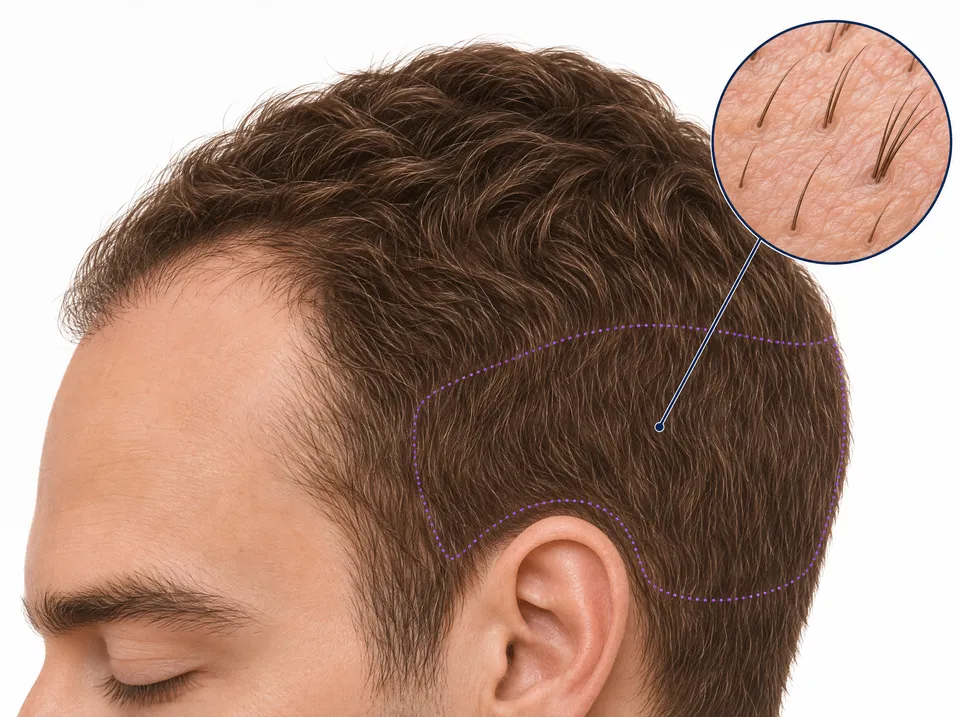 Step 1
Personalised anatomical planning
Your hair structure, donor capacity, the state of your hair loss and your anatomical features are assessed by a specialist doctor. The number of grafts needed and the surgery plan are determined.
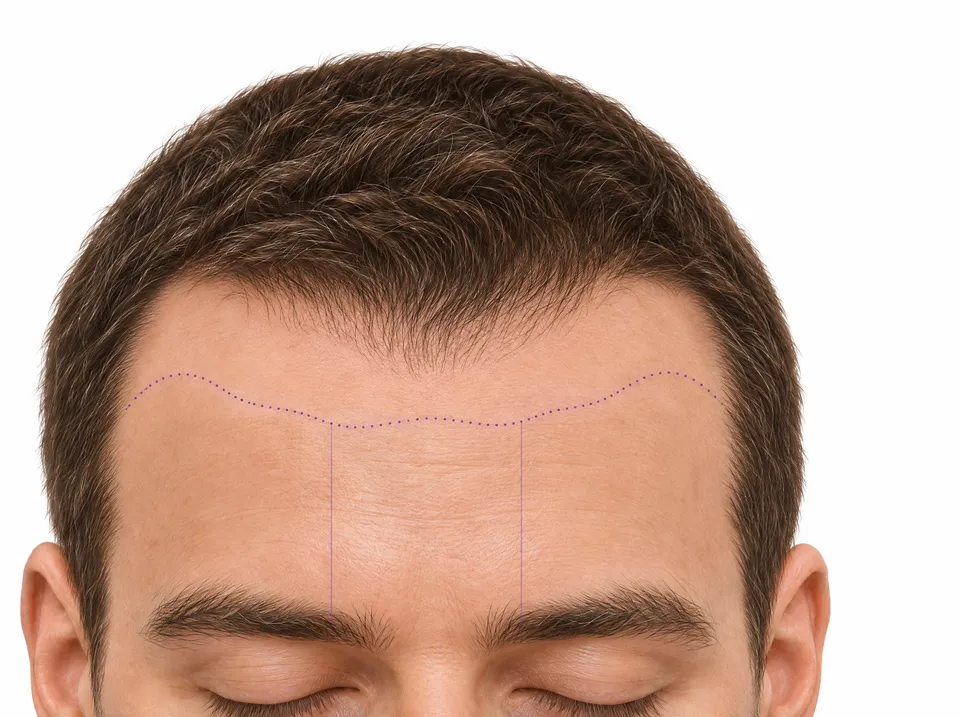 Step 2
Hairline design
A hairline tailored to you is designed, taking into account your facial proportions, your age, your existing hair and the natural direction in which your hair grows.
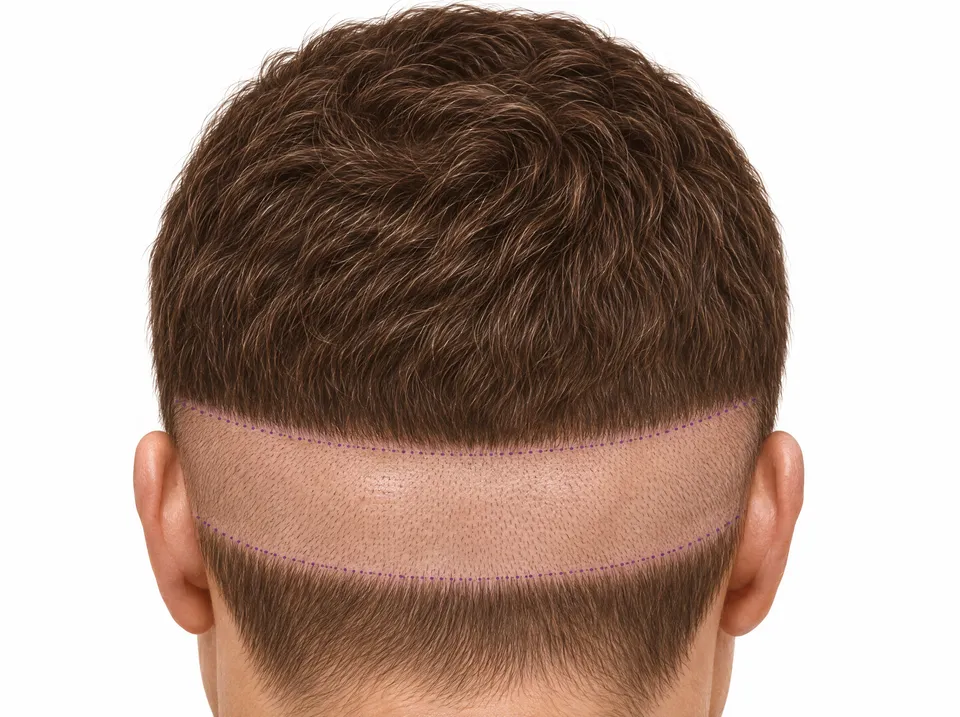 Step 3
Preparing the donor area with local anaesthesia
Local anaesthetic agents are applied to the donor area, numbing it temporarily.
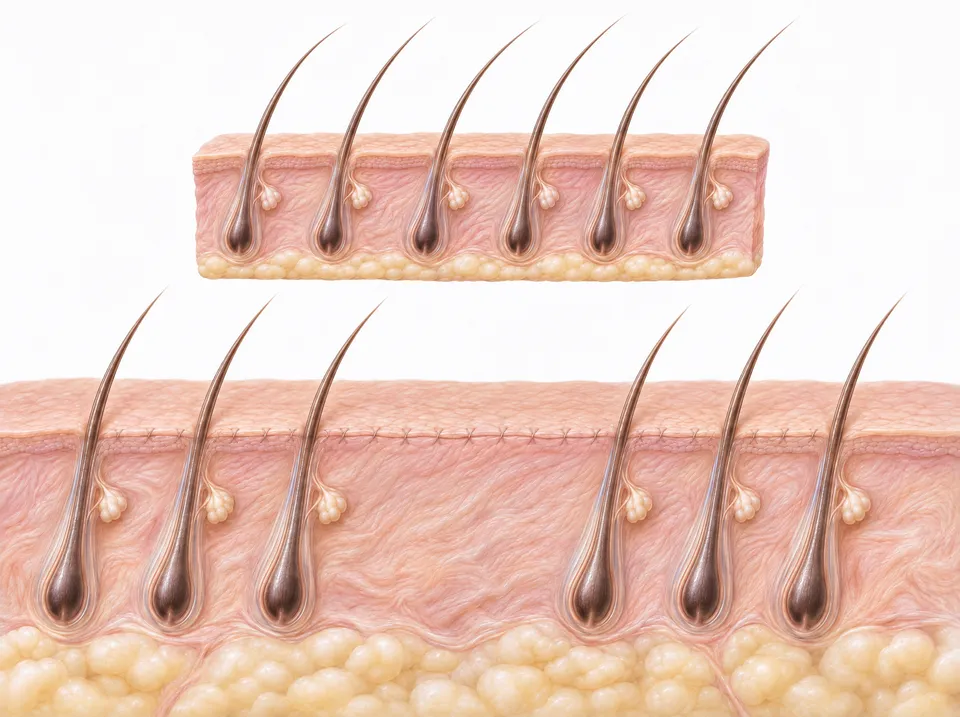 Step 4
Removing the strip of skin from the donor area
A strip of skin of suitable width and length, containing hair follicles, is surgically removed by a specialist doctor. The incision in the donor area is closed using an appropriate surgical technique.
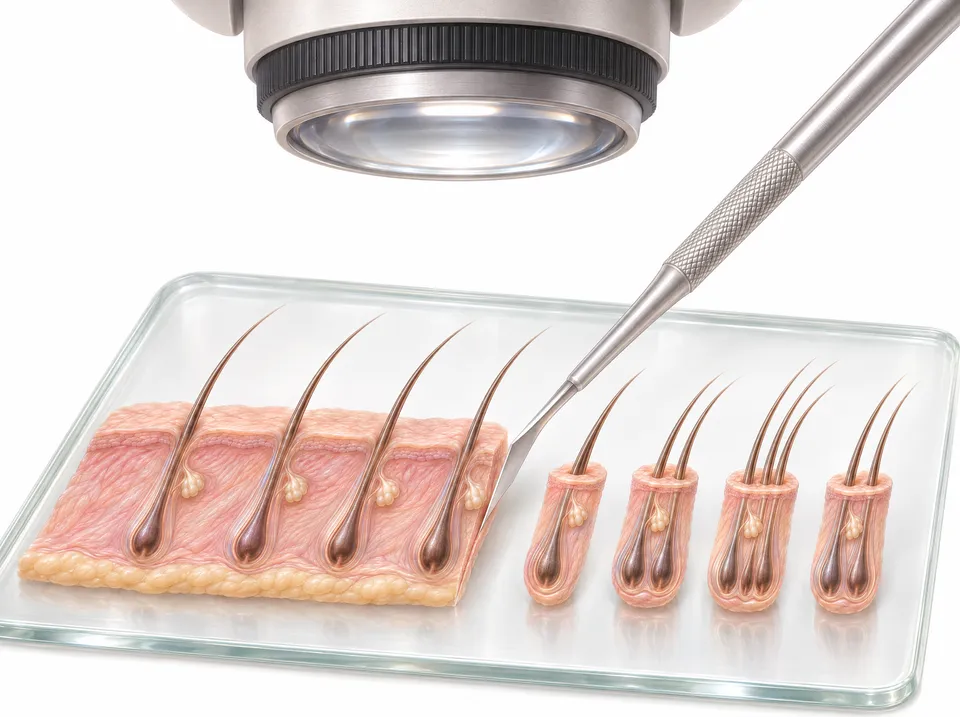 Step 5
Dividing the grafts under a microscope
The strip of skin is divided into follicular units under a microscope. The grafts are sorted by the number of hairs they contain and by their structural features.
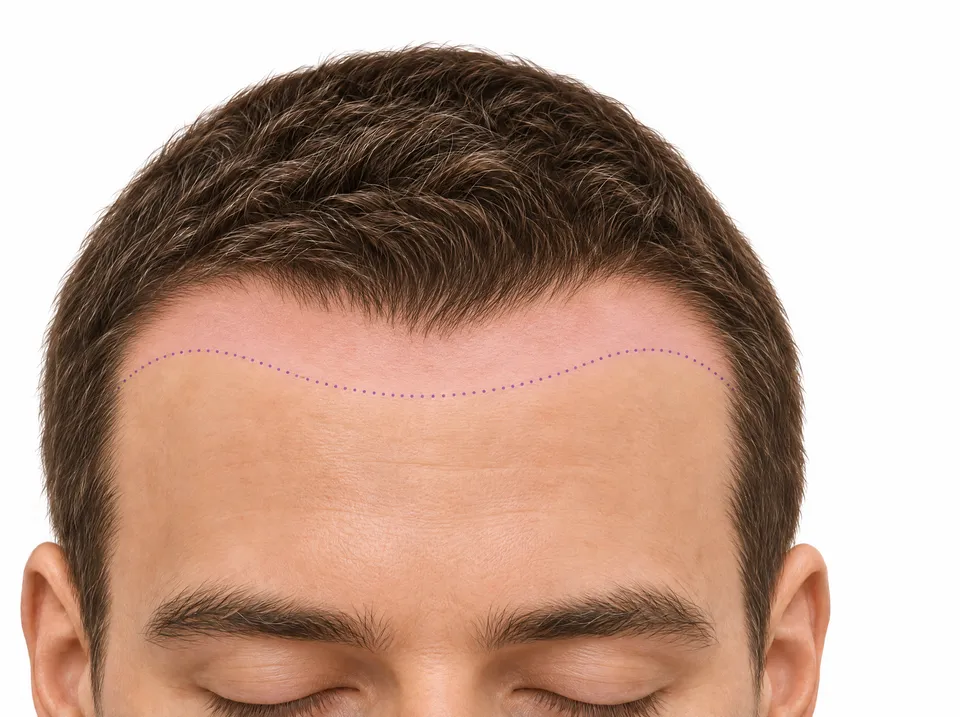 Step 6
Preparing the recipient area with local anaesthesia
Local anaesthetic agents are applied to the area to be transplanted, numbing it temporarily.
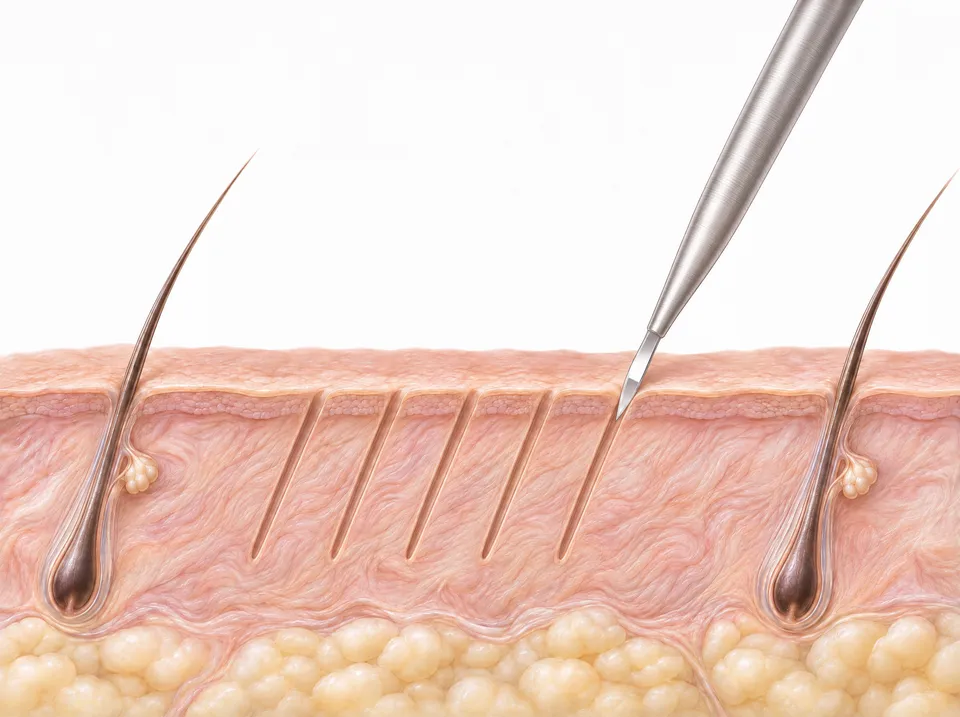 Step 7
Opening channels in the recipient area
The channels that will hold the grafts are created with suitable surgical instruments, following the direction and angle of your existing hair, your anatomical features and the planned density.
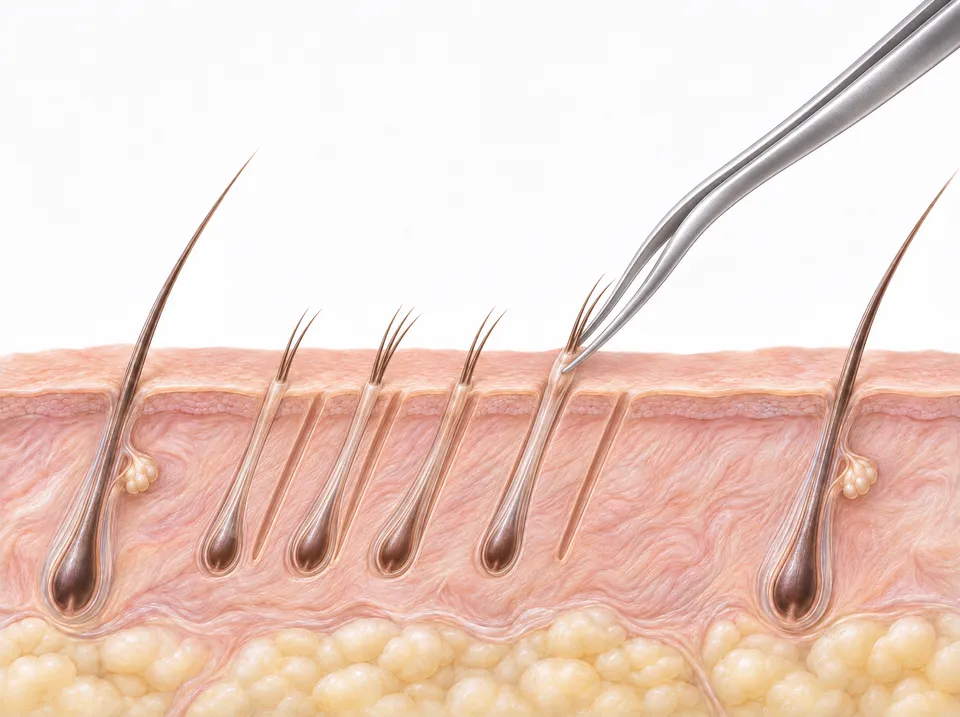 Step 8
Placing the grafts
The follicular units separated under the microscope are placed in the recipient area according to the planned channels and placement pattern.


The images are illustrations; no surgery photos are used.
Recovery timeline
The first two weeks
- Day 1
Surgery
The procedure is carried out according to the surgery plan prepared for you.
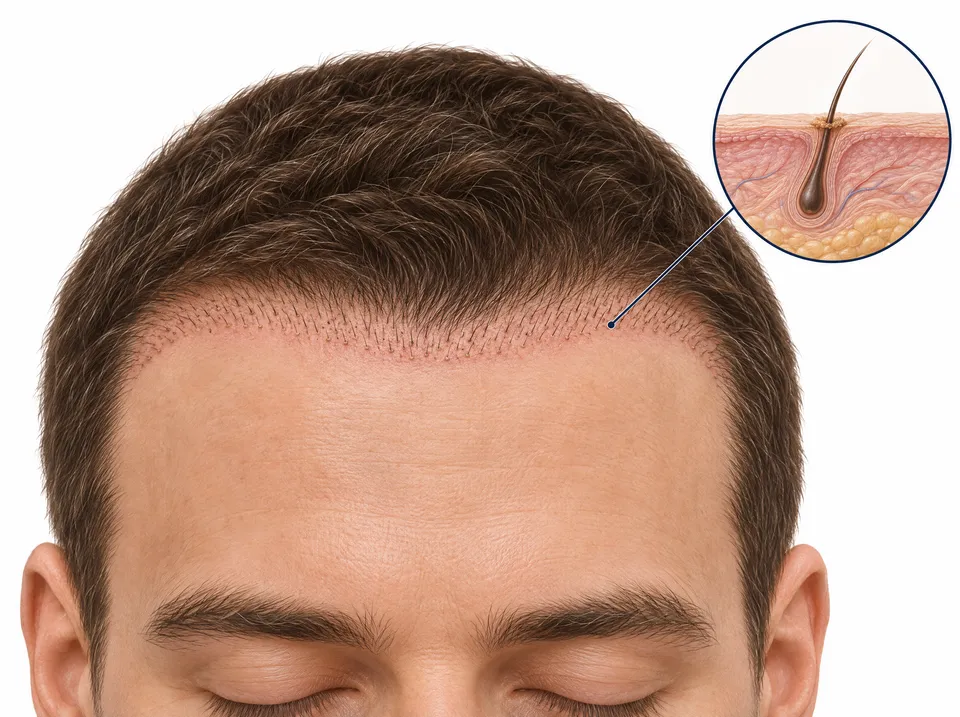
- Day 2
First check-up and dressing
The treated area and the stitch line at the back of the head are checked. The necessary medical assessment and dressing are carried out.
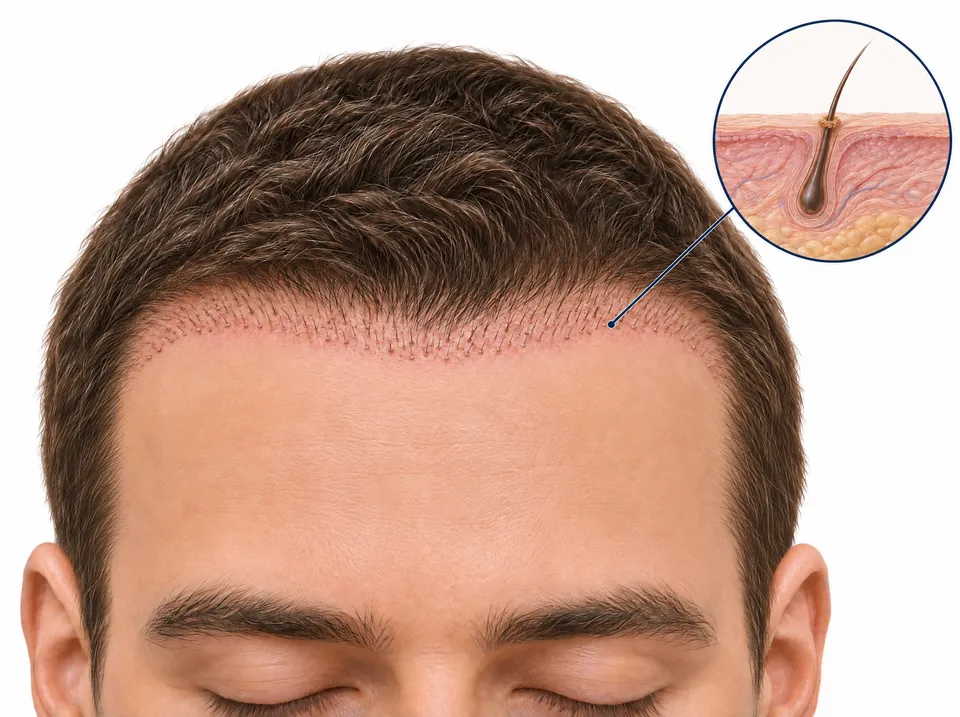
- Day 3
Initial care and check-up
The necessary initial care, check-up and follow-up are carried out, and your first wash takes place at this stage. What you need to watch out for after surgery is explained to you in detail.
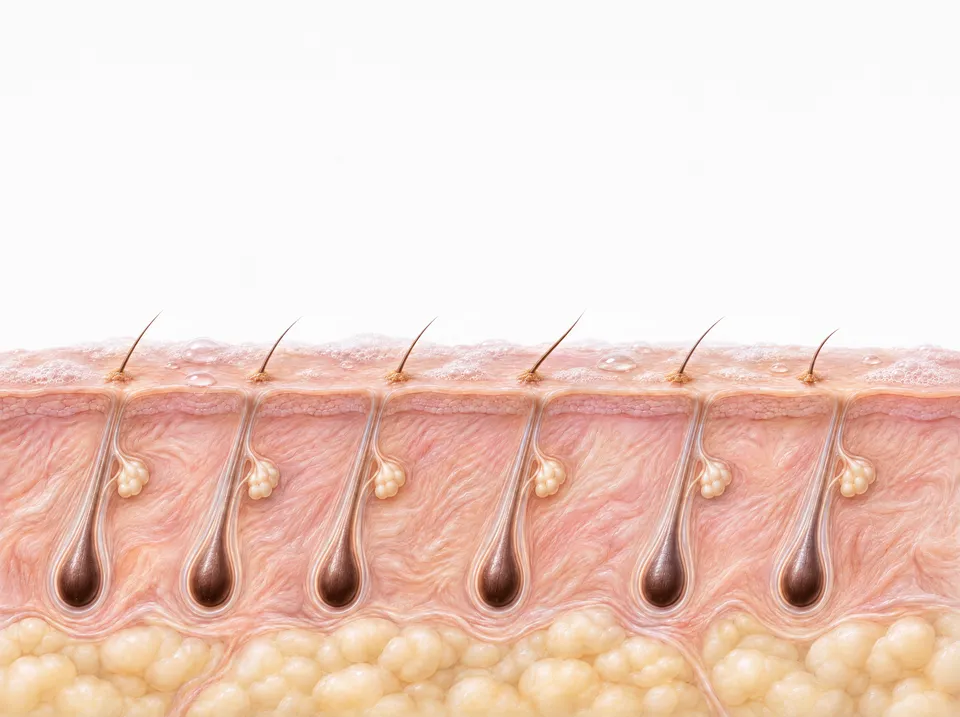
- Day 10
Scab wash
A wash is done to remove the scabs that have formed in the treated area in a controlled way. How the scabs are clearing is assessed according to how you are healing.
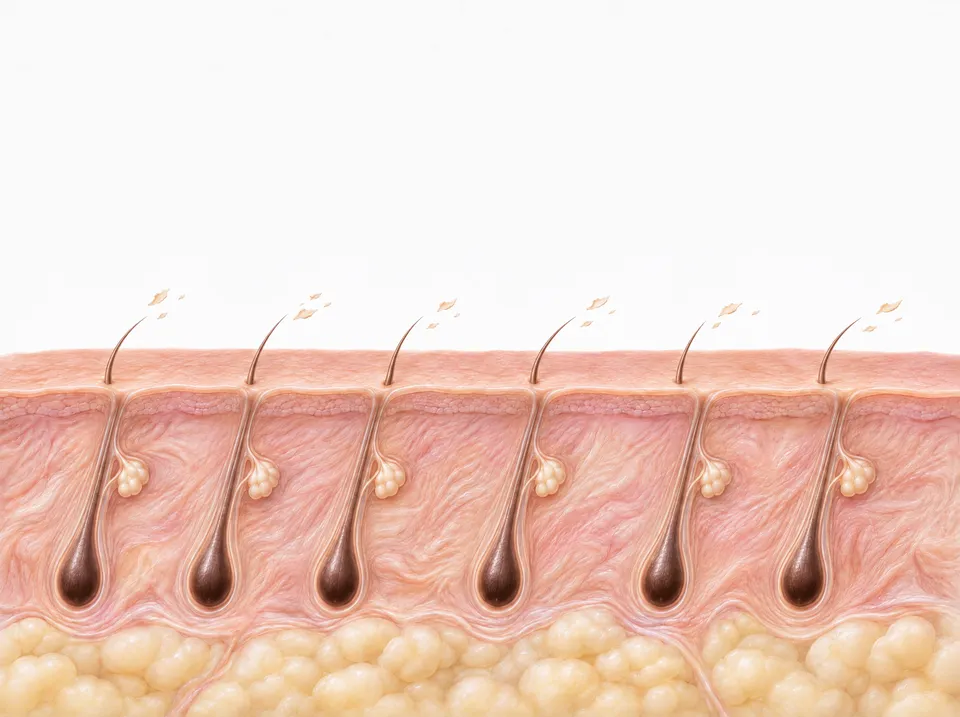
- Day 15 onwards
Shock loss begins
The transplanted hairs may start to shed temporarily. This does not mean the hair follicles have been lost.
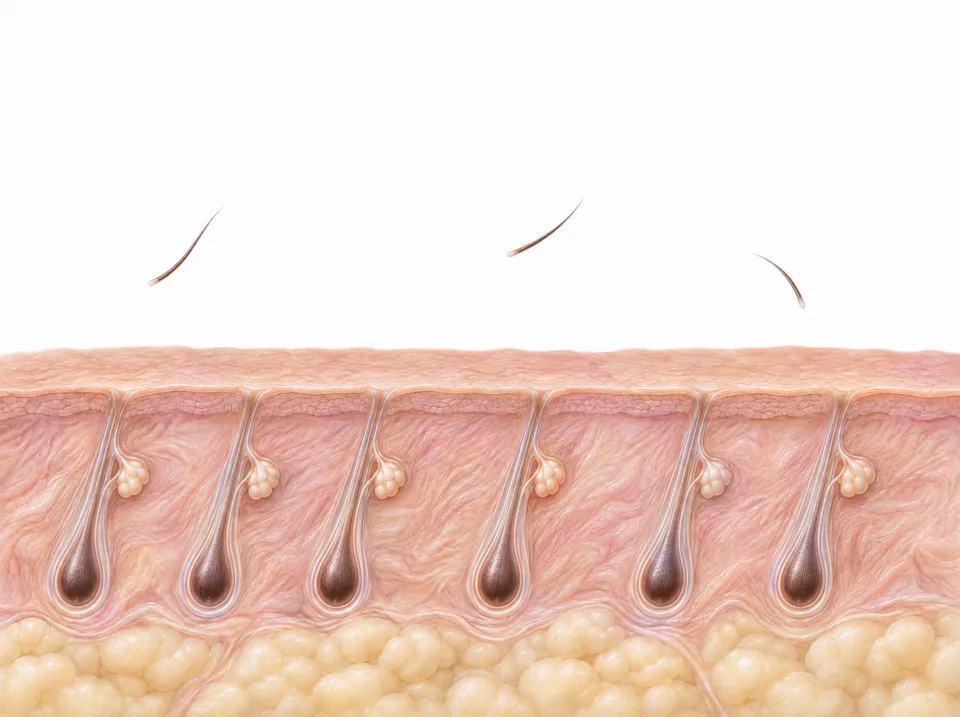


Over the months
- Day 15 – month 3
Shock loss phase
Some of the transplanted hairs may shed during this period. The hair follicles, meanwhile, keep developing under the skin to produce new hair.
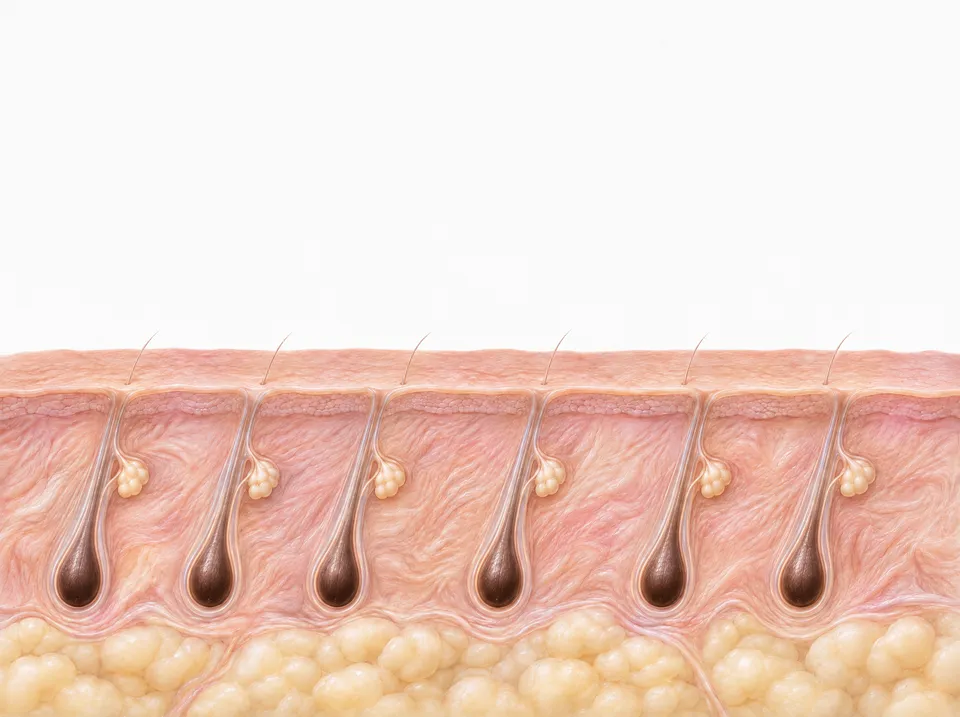
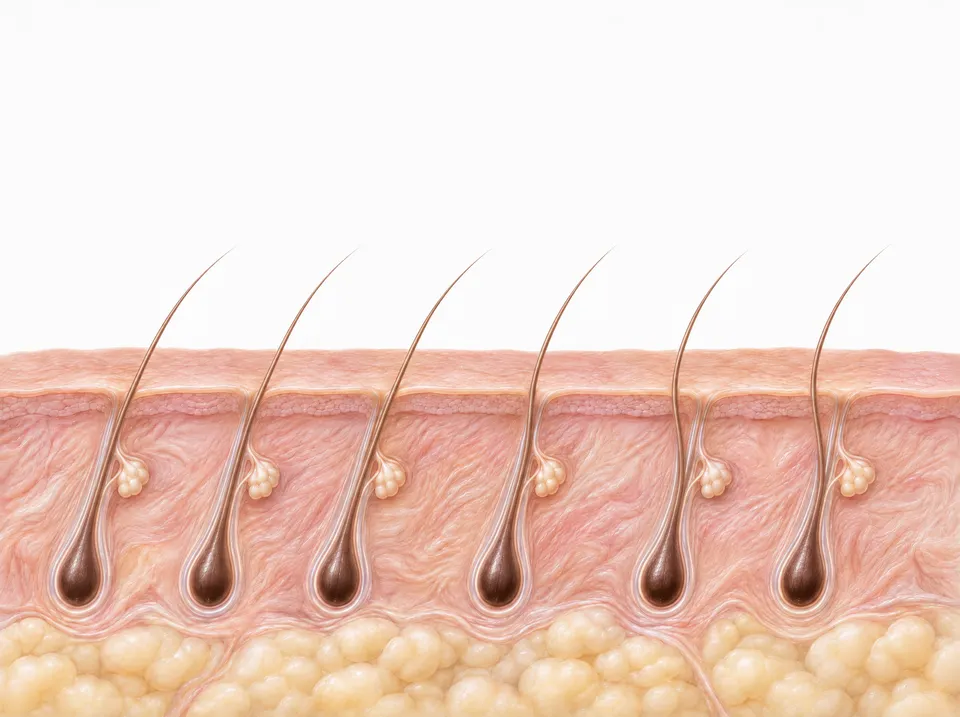
- Month 3
New hair comes through
New hairs may start to become visible. The first hairs may be fine and grow in different directions.
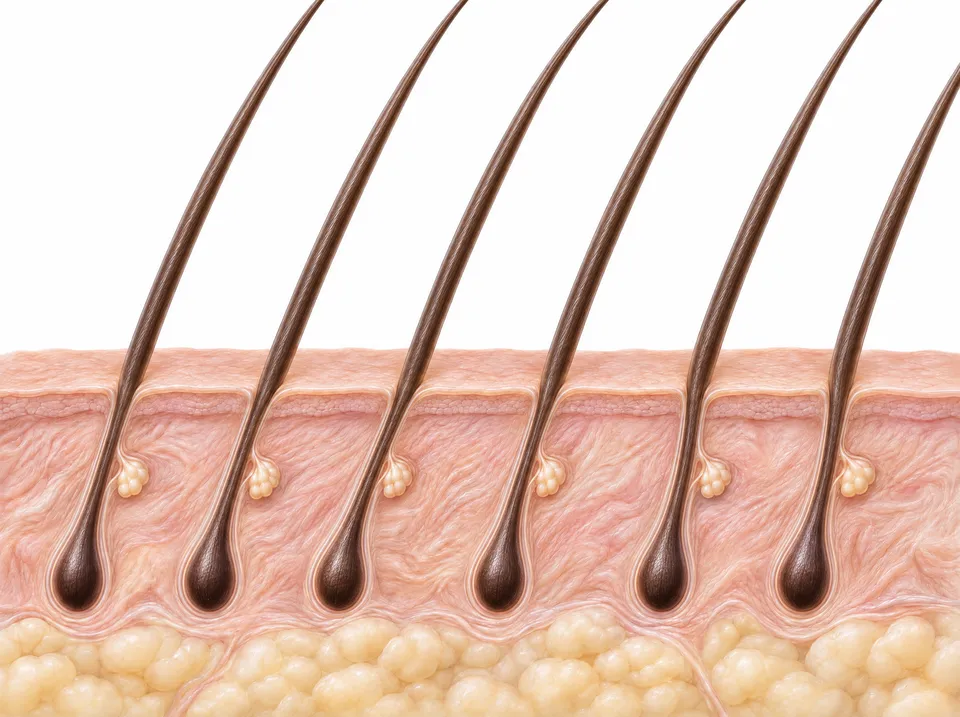
- Months 4–6
Hair growth and density
New hairs keep coming through, growing longer and thickening. A gradual increase in density may be seen.
- Months 8–12
Results become clearer
Hair growth and density continue to build, and the results become more noticeable during this period. The final assessment is made according to your hair growth and clinical condition.
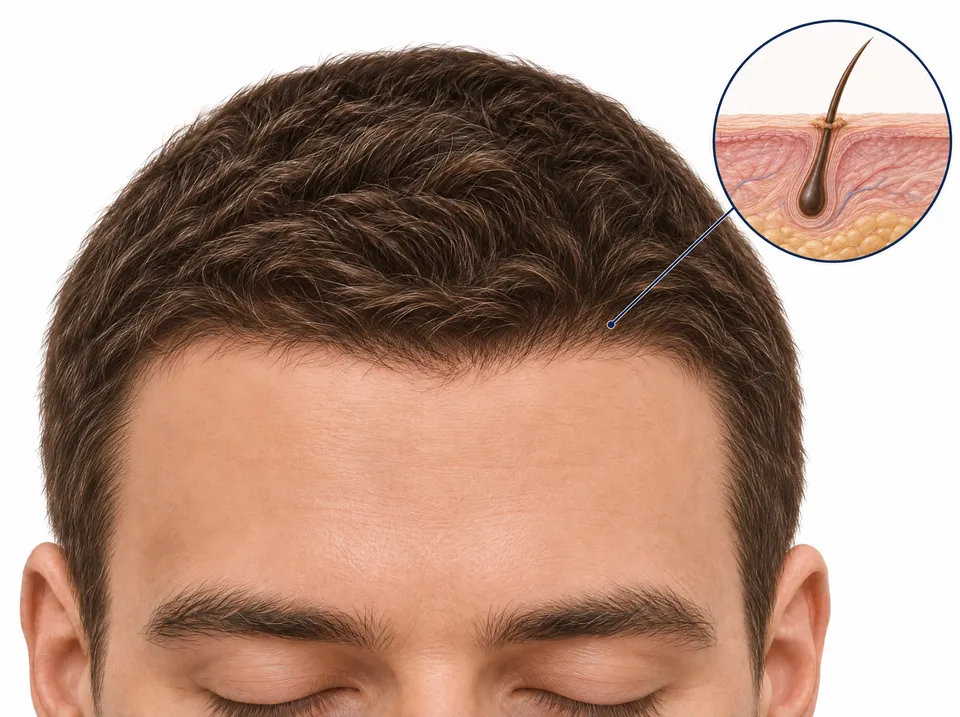


Representative images
Timings are averages and vary from person to person. The drawings are schematic sections of the scalp.
Risks and side effects
Every procedure carries risks. Most are temporary; your doctor goes through each one with you before surgery.
Linear scar at the back of the head
A thin, linear scar may form where the strip was taken. Once the hair grows, it is usually covered; with a very short cut it may be visible. The scar can widen if the scalp is tight or a wide strip is taken, which is why scalp elasticity is assessed during planning.
Wound separation and thick scarring
If the stitch line is under tension, the wound may separate; in some people the scar may thicken (a hypertrophic scar or keloid). If you have had thick scars before, be sure to mention it at the examination.
Numbness and nerve pain
Reduced sensation may occur around the stitch line and on the top of the head; it usually fades within months and rarely lasts longer. Very rarely, nerve pain at the back of the head (occipital neuralgia) can occur.
Tightness and pain at the back of the head
Tightness and pain along the stitch line are normal in the first days and usually ease within the first few days. One comparison found more pain after FUT than after FUE.
Swelling
Around the forehead and eyes; it usually settles within 5–7 days. If it gets bad enough to close your eyes, message us.
Shock loss
The transplanted hairs and your own hair nearby may shed temporarily after day 15; the roots stay under the skin and the hair starts to grow back around month 3.
Infection
Rare, usually in the first 1–4 weeks. If you have a fever, increasing redness or discharge from the stitch line, message us without delay.
Frequently asked questions
FUT or FUE?
Both methods yield good-quality grafts; the difference lies in how the grafts are taken and in the shape of the scar. With FUT, a single linear scar may form at the back of the head; with FUE, small scattered, dot-like scars remain. Your scalp elasticity, the number of grafts you need and how short you wear your hair determine the choice.
Who decides which technique suits me?
You have a face-to-face or online consultation (video call or phone) with our specialist doctor and our hair transplant specialists Hüseyin Can Ebil and Hakan Dağdelen. The reasons behind the technique and the plan are explained to you in detail.
Will my hair be shaved for FUT?
In the donor area, only the narrow band where the strip will be taken is trimmed short; the hair above it covers the stitch line. How the recipient area will be prepared is discussed during planning.
Can FUT and FUE both be done on the same person?
Yes. In some people the two methods can be planned together, in the same session or in separate sessions. This decision is based on your donor capacity and the number of grafts you need.
How many nights should I stay in Istanbul?
If you are travelling from outside Istanbul, a stay of at least 3 nights is recommended. The check-up, dressing and first wash in the first three days take place during this time; the length of stay may vary depending on the surgery and your needs.
When are the stitches removed?
Either self-dissolving stitches or stitches that need to be removed may be used. Which type is used and when the stitches will be checked are given to you in writing.
Will the scar at the back of my head be visible?
A thin linear scar may form where the strip was taken. Once the hair grows, it is usually covered; with a very short cut it may be visible. Every hair transplant method leaves some kind of scar.
Does recovery go the same way for everyone?
No. Because every surgery is planned individually, recovery time, check-up intervals and results can vary from person to person. Follow-up and care recommendations are set according to the specialist doctor's assessment.
Is there pain after FUT?
In the first days you may feel tightness and pain at the back of the head. One study reported that pain after FUT had largely eased by day 3; advice on painkillers is given to you in writing.
References
- 1.Dua K, Uprety S, Dua A. Donor harvesting: strip dissection. J Cutan Aesthet Surg. 2018;11(4):190–194.
- 2.Park JH. Association between scalp laxity, elasticity, and glidability and donor strip scar width in hair transplantation and a new elasticity measuring method. Dermatol Surg. 2017;43(4):574–581.
- 3.Gupta AK, Love RP, Harris JA. Old friend or new ally: a comparison of follicular unit transplantation and follicular unit excision methods in hair transplantation. Dermatol Surg. 2020;46(8):1078–1083.
- 4.Kim YS, Na YC, Park JH. Comparison of postoperative pain according to the harvesting method used in hair restorative surgery. Arch Plast Surg. 2019;46(3):241–247.
- 5.Liu RH, Xu LJ, McCarty JC, Xiao R, Chen JX, Lee LN. A scoping review on complications in modern hair transplantation: more than just splitting hairs. Aesthetic Plast Surg. 2025;49(3):585–595.
- 6.Jimenez F, Vogel JE, Avram M. CME article Part II. Hair transplantation: surgical technique. J Am Acad Dermatol. 2021;85(4):818–829.
- 7.Siefferman J, Khelemsky Y. Occipital neuralgia after hair transplantation and its treatment. Case Rep Neurol Med. 2015;2015:428413.
Let's review yourhair together.
Tell us about your hair in three short steps, and your hair transplant specialist will get back to you.
- Address
- Ataköy 7-8-9-10. Kısım Mahallesi, Çobançeşme E-5 Yan Yol Caddesi No: 20/1, Ataköy Towers A Blok, 5. Kat, Ofis No: 96, Bakırköy / İstanbul
- Opening hours
- 24/7, every day of the week
- Phone
- +90 (545) 209 55 51