



Hair transplant
Hair transplant techniques, treatment areas and one principle: your hair transplant specialist reviews your photos and suggests the plan that suits you; you decide together.

Short answer
A hair transplant moves hair roots (grafts) from the zone resistant to hair loss, at the back and sides of the head, to thinning areas. It is done under local anaesthesia, usually in a single day. Techniques differ in how grafts are taken and how channels are opened. New hair starts to grow around month 3; the result is assessed at month 12.
What is a graft?
Under the skin, hairs do not grow singly but in small groups. A hair transplant moves these natural groups, not individual hairs.


What is a graft?
Under the skin, hairs do not grow singly but in small groups. A hair transplant moves these natural groups, not individual hairs.
Head
The back and sides of the head are the areas most resistant to hair loss. Grafts are taken from here.
- Donor area Back and sides; grafts are taken from here.
Skin
Up close, you can see hairs emerging from the skin in small bundles.
- Follicular unit opening 1–4 hairs emerge from each opening.
Cross-section
Each bundle is a follicular unit: 1–4 hair roots, a sebaceous gland and a fine muscle, held together as one unit.
- Epidermis (outer skin)
- Dermis (inner skin)
- Subcutaneous fat
- Follicular unit 1–4 hair roots
- Sebaceous gland
Graft
Single-hair grafts go at the very front of the hairline; grafts with 2–3 hairs further back add density.
- Single hair Very front of the hairline
- Two hairs Front zone, transition
- Three hairs Mid zone
- Four hairs Crown, density
Schematic drawing. The number of hairs in a follicular unit varies from person to person.
The techniques compared
The differences lie in how the grafts are taken, what the channels are opened with and how the grafts are placed.
- Shaving
- Shaven, unshaven and partially shaven
- Shared by all
- Local anaesthesia, one session; scabs are washed off around day 10, and the result is assessed at month 12.
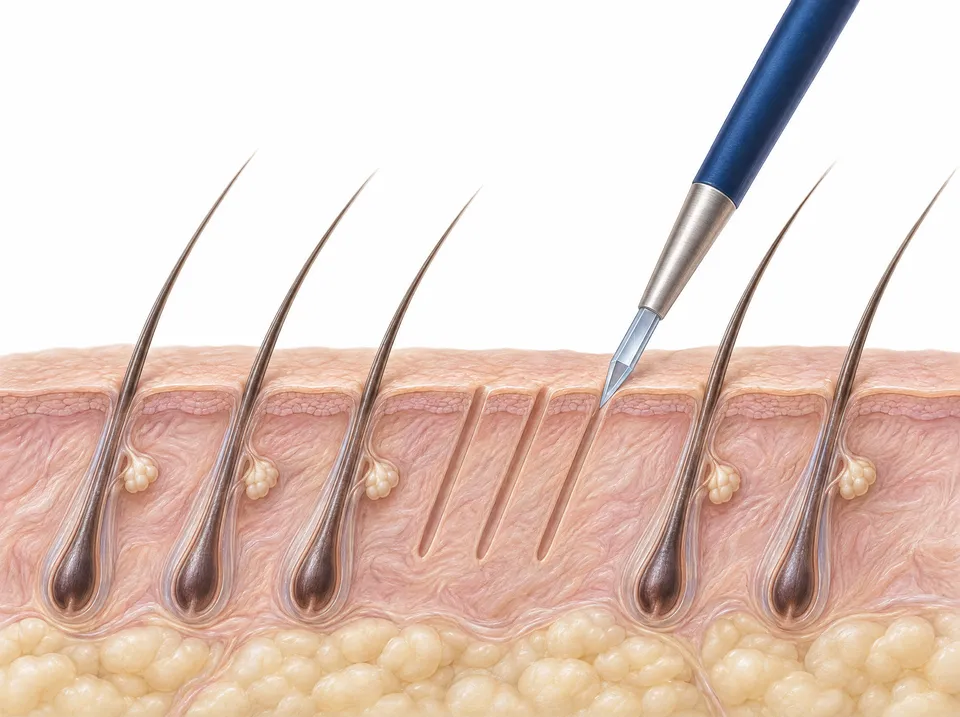 Sapphire FUEFeatured
- Channel opening
- Sapphire blade
- Placement
- With implantation forceps, into the opened channel
- Often planned for
- Large areas
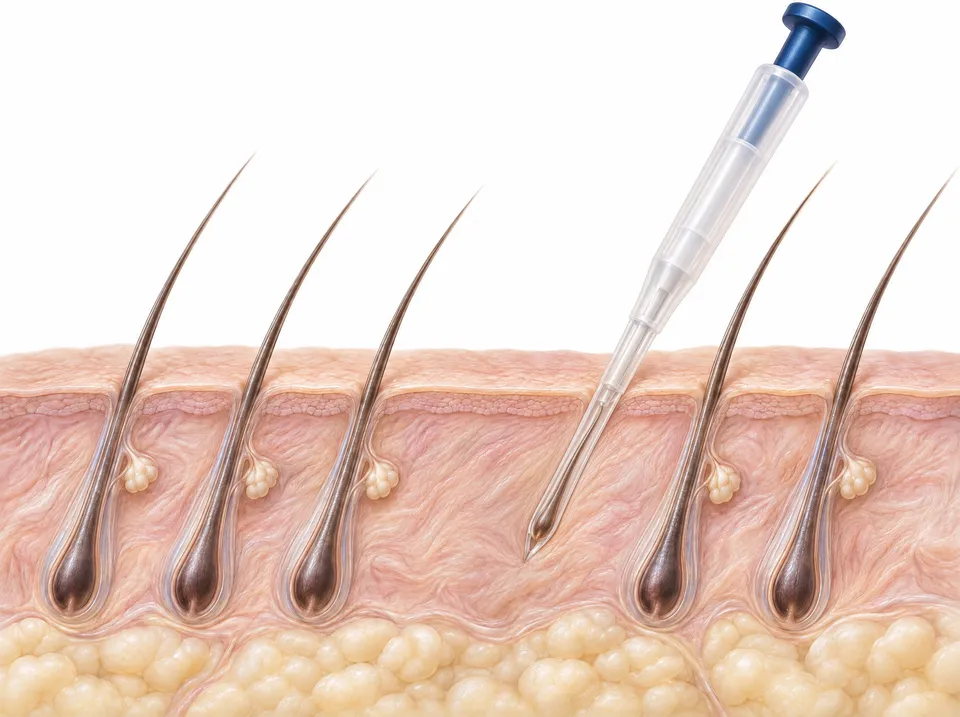
- Channel opening
- Implanter pen, in one step
- Placement
- Implanter pen
- Often planned for
- Between existing hair
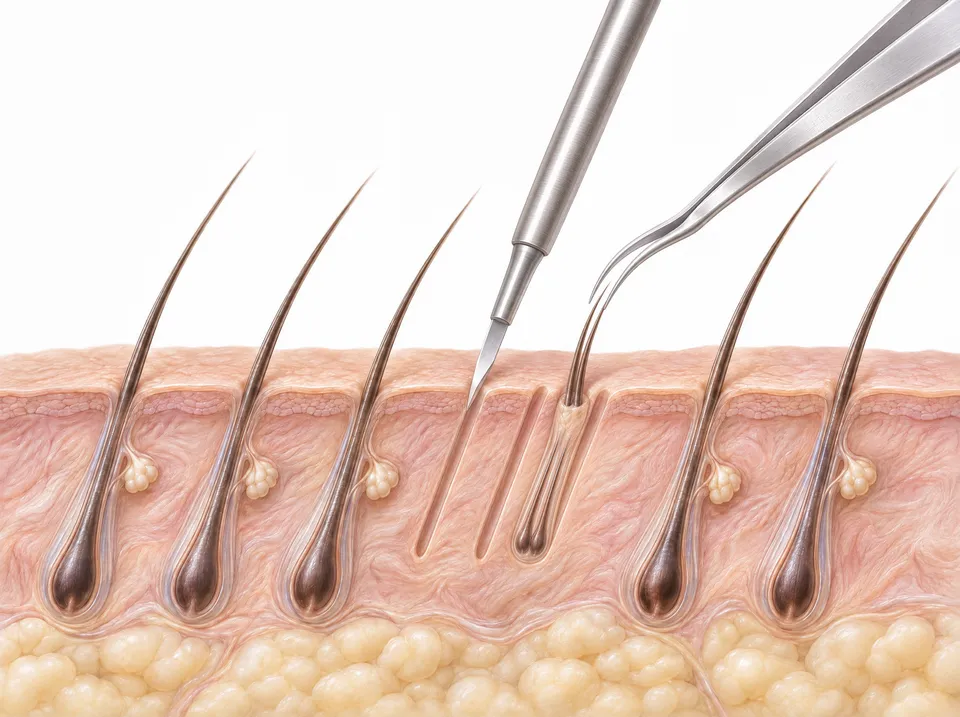
- Channel opening
- Medical steel blade
- Placement
- With implantation forceps, into the opened channel
- Often planned for
- Large areas
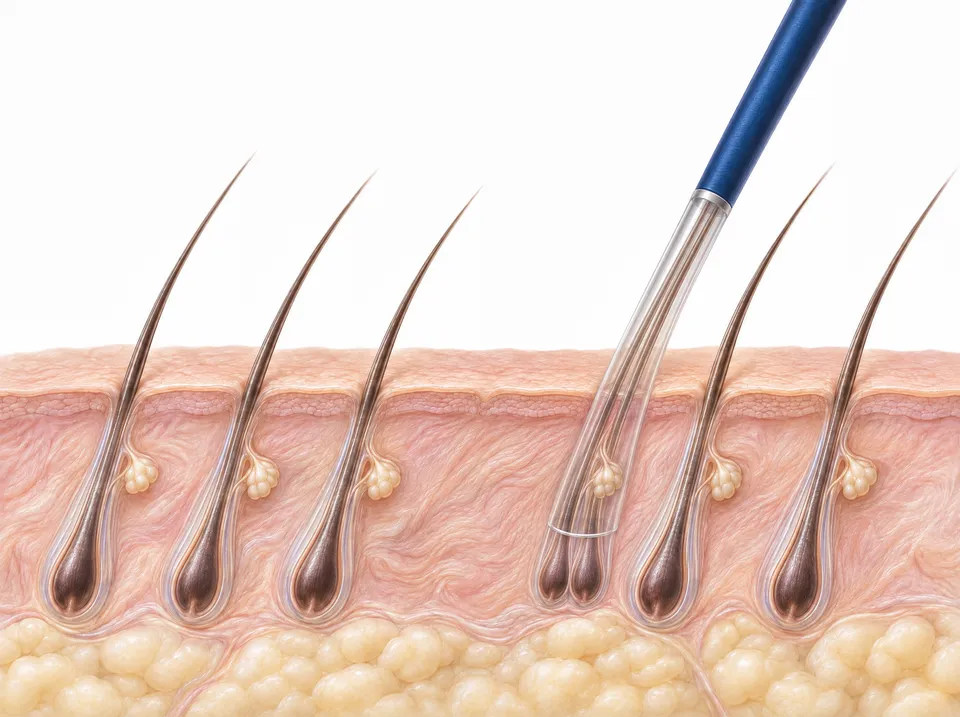
- Channel opening
- Sapphire blade
- Placement
- Forceps or implanter pen
- Often planned for
- Large areas
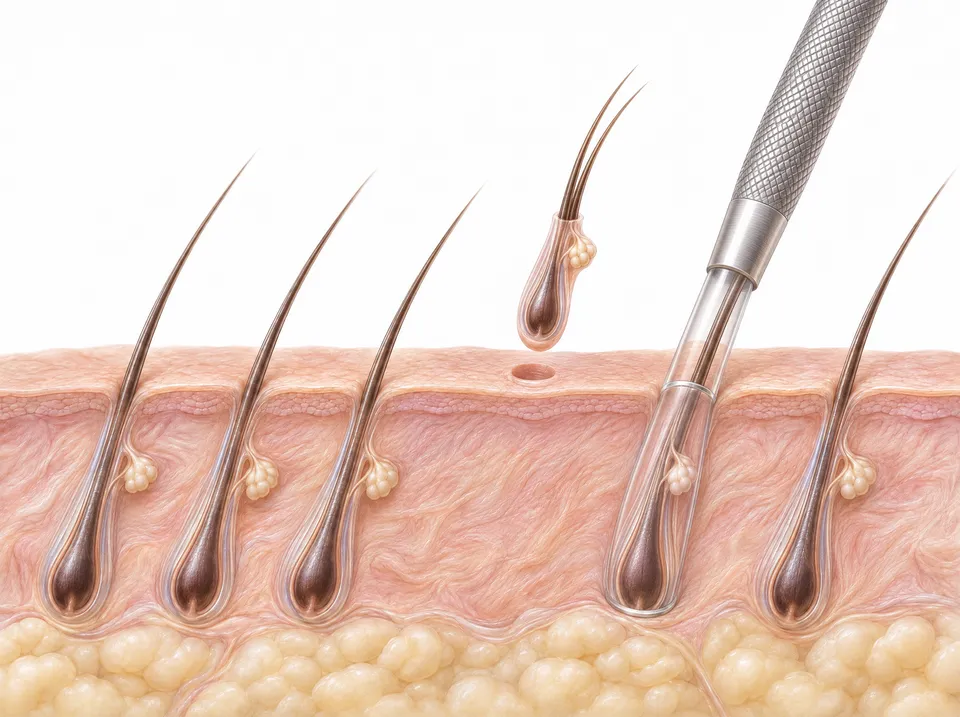
- Channel opening
- Medical blade
- Placement
- Forceps or implanter pen
- Often planned for
- Fine hair, scars, revisions
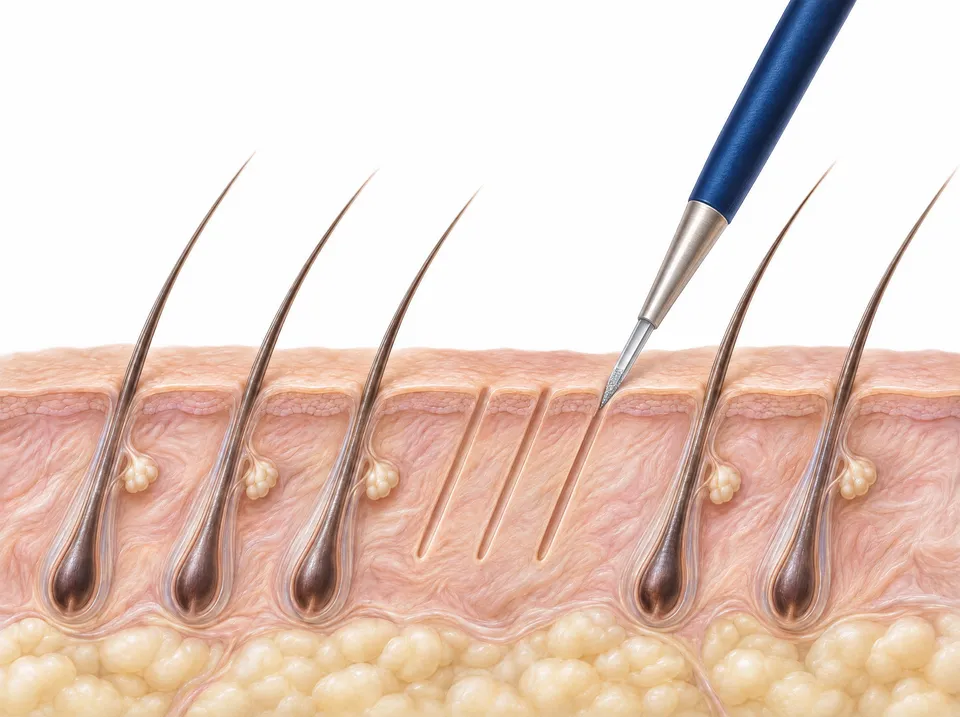
- Channel opening
- Medical diamond blade
- Placement
- Forceps or implanter pen
- Often planned for
- Delicate tissue, scars, revisions
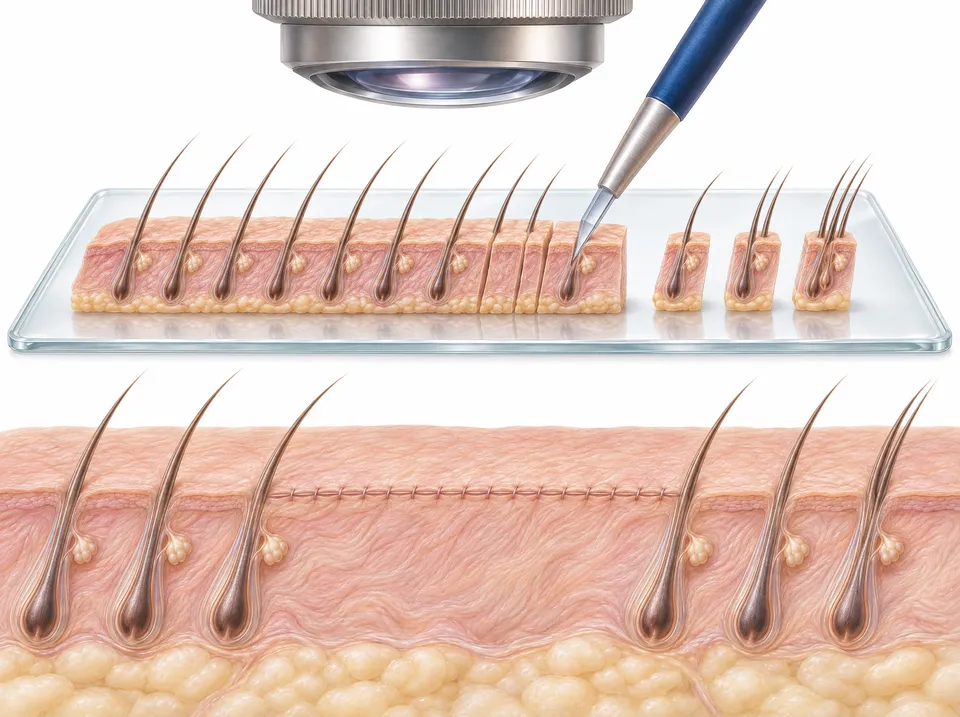
- Channel opening
- Medical blade
- Placement
- Forceps or implanter pen
- Often planned for
- Large areas that need many grafts
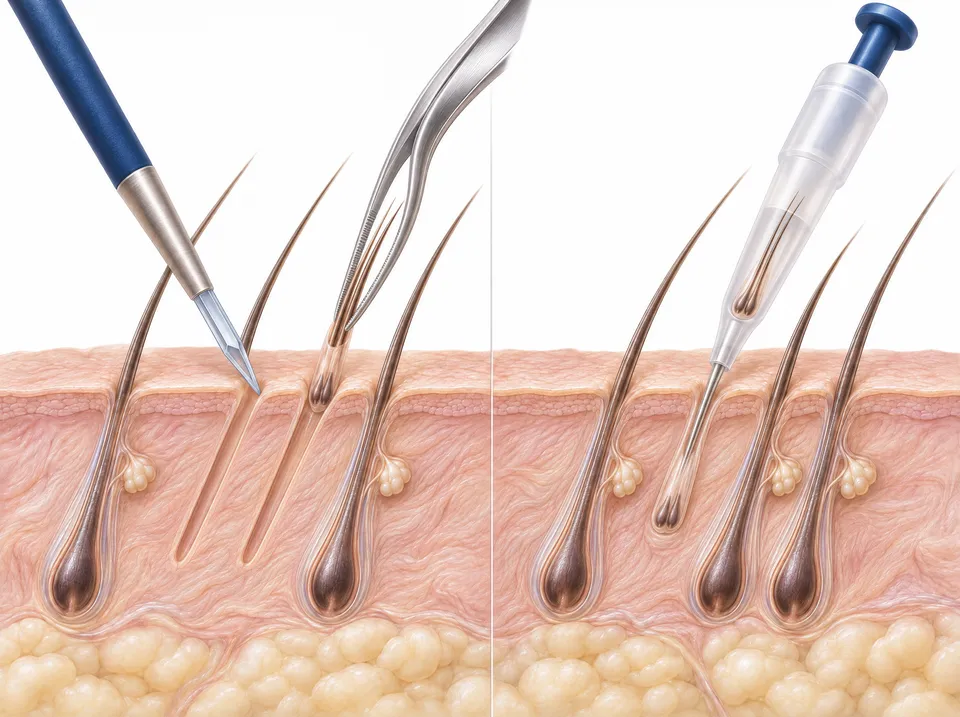
- Channel opening
- Sapphire and DHI technique
- Placement
- By zone: into the channel or directly with the implanter pen
- Often planned for
- Recipient zones with different needs


These values are general information; your doctor decides on the technique and number of grafts that suit you. Representative images
Which one suits me?
Answer three questions to see the options worth discussing with your doctor. This is not a diagnosis.
How do you feel about having your hair cut short?
Where is the thinning most visible?
Do you still have hair in the area to be treated?
Options to discuss with your doctor
Scroll the table sideways
| Question | Sapphire FUE | Classic FUE | DHI |
|---|---|---|---|
| 01 | · | · | · |
| 02 | · | · | · |
| 03 | · | · | · |
| Match count | 0 | 0 | 0 |
The table fills in as you answer.
The final decision is made after the examination, based on your donor area and how your hair loss is progressing.
Hair transplant techniques
The technique pages explain the process, recovery, risks and frequently asked questions in detail.
Classic FUE
Grafts are extracted one by one; channels are opened with steel blades.
Explore the techniqueSapphire FUE
Grafts are taken one by one; channels are opened with a sapphire blade, its size chosen to match the grafts.
Explore the techniqueMicro FUE
Grafts are taken one by one with micro punches chosen to suit the hair; channels are opened with a sapphire blade.
Explore the techniqueManual FUE
Grafts are taken one by one with a hand-controlled micro punch; it may be preferred for very fine hair, scars and revisions.
Explore the techniqueDiamond FUE
Grafts are taken one by one with a punch; channels are opened with a medical diamond blade, planned to suit the tissue.
Explore the techniqueDHI
The implanter pen opens the channel and places the graft in one step.
Explore the techniqueFUT
Grafts are separated under the microscope from a thin strip of scalp taken from the back of the head.
Explore the techniqueHED Hybrid Hair Transplant
FUE and DHI are combined in one operation; the technique for each zone is chosen in the plan.
Explore the technique


Representative images
Norwood scale (Norwood-Hamilton)
A clinical assessment scale used to classify the stages of male pattern hair loss (androgenetic alopecia).
The Norwood scale assesses how hair loss progresses, particularly at the frontal hairline, the temples and the crown (vertex), in 7 main stages.

Normal hairline
The hairline keeps its youthful position. There is no noticeable recession at the temples.
Slight frontal recession
The temples begin to recede slightly and an M-shaped hairline starts to form.
Clear temple recession
The frontal hairline recedes clearly. This is considered the first stage of clinically significant male pattern hair loss.
Frontal and crown loss
The front hairline recedes and a clear bald spot forms at the crown. A band of hair remains between the two areas.
Advanced hair loss
The frontal and crown areas grow larger. The band of hair between them becomes thinner.
Extensive hair loss
The bald areas at the front and the crown merge. Hair remains mostly at the sides and the back.
Most advanced stage
Hair remains only in a narrow horseshoe shape at the sides and the back of the head. Donor area capacity may be limited.
Treatment areas
Hair transplants are not only for the hairline: they are also planned for the beard, the eyebrows and special cases.
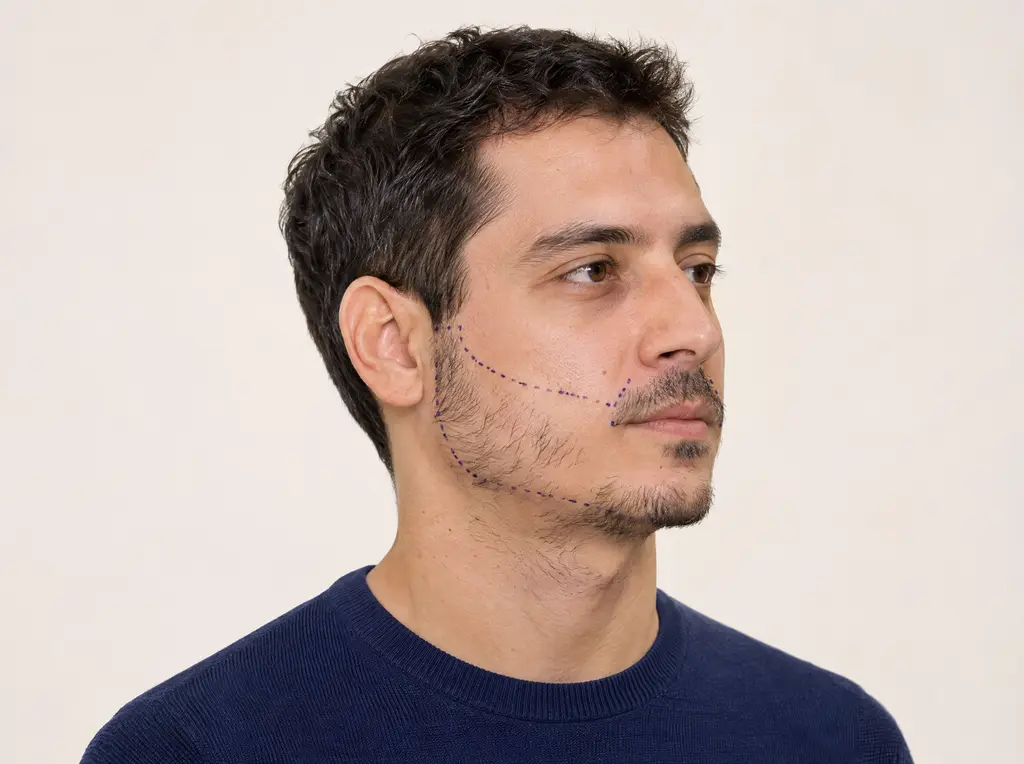
Beard and Moustache Transplant
Sparse or bare patches, planned around your facial features.
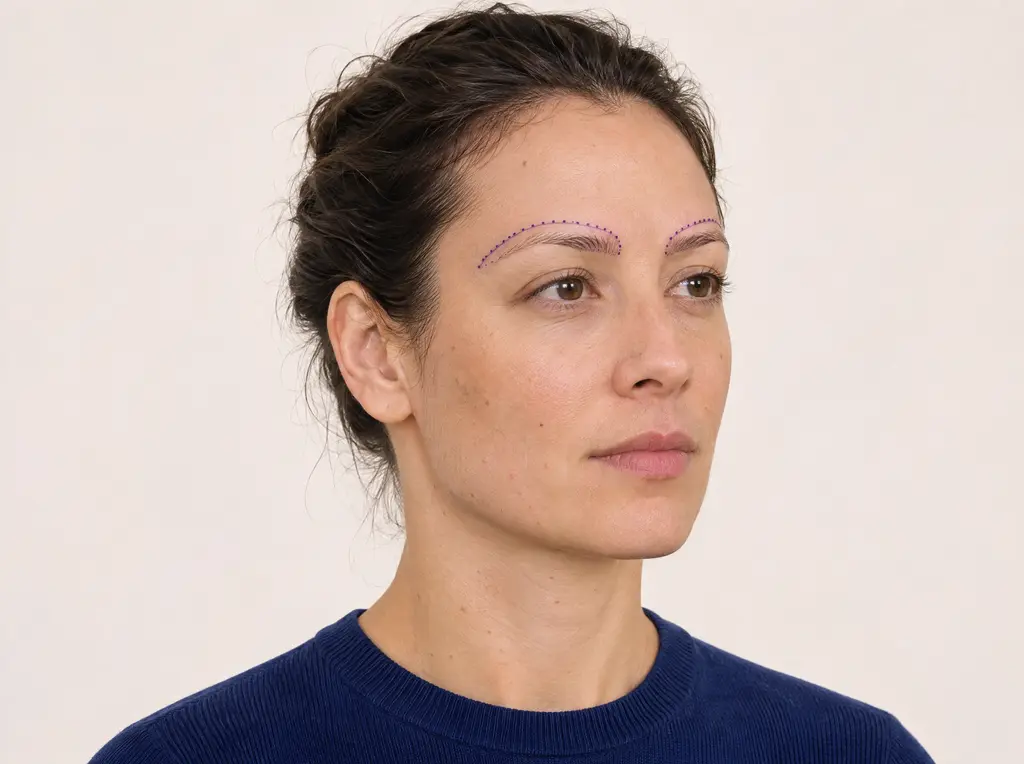
Eyebrow Transplant
Individual hair follicles, placed at the natural angle of growth.
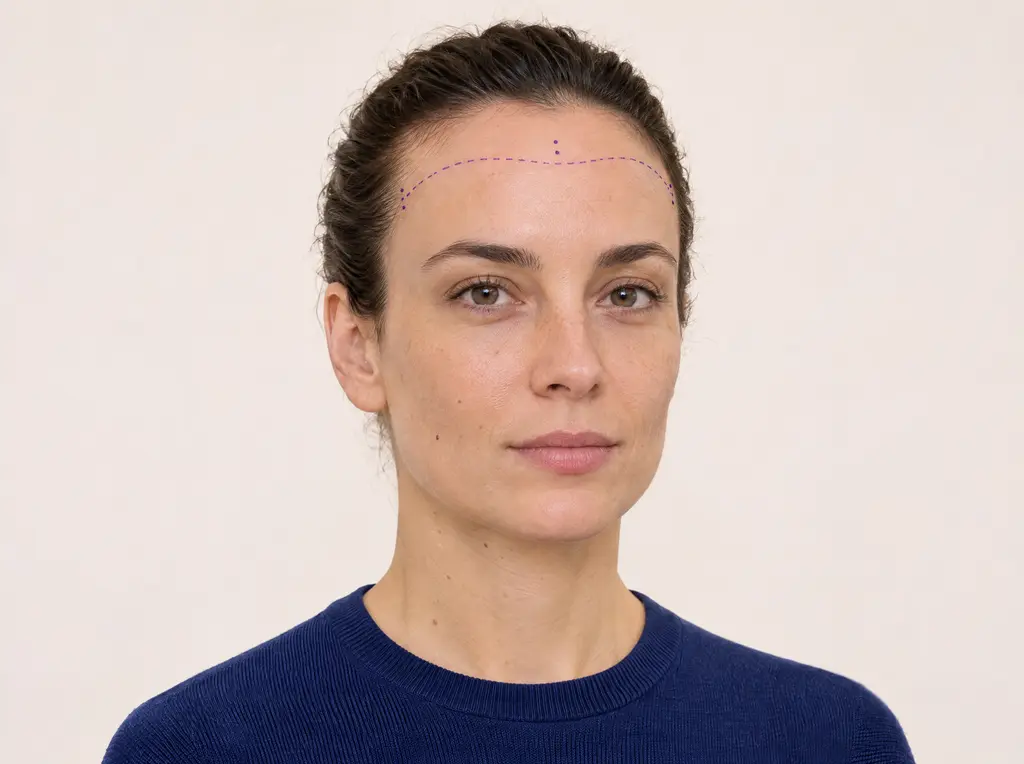
Hairline lowering
A new front line drawn to your facial proportions and created with a hair transplant.
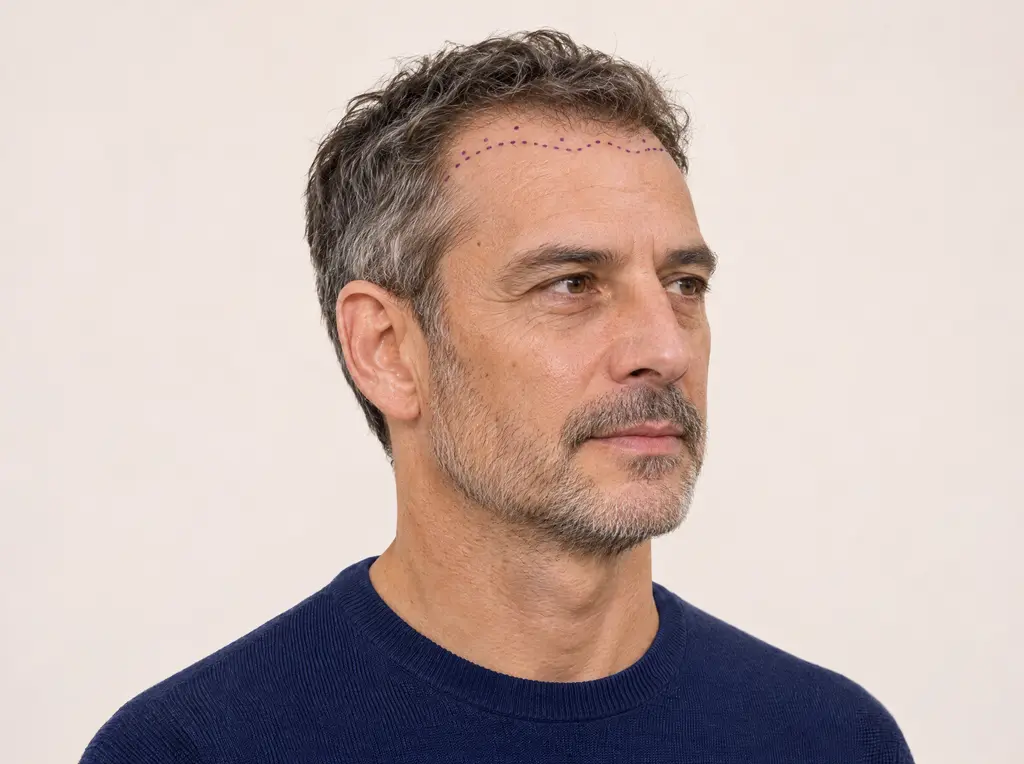
Revision Hair Transplant
A correction plan based on the earlier transplant's hairline, density and donor capacity.
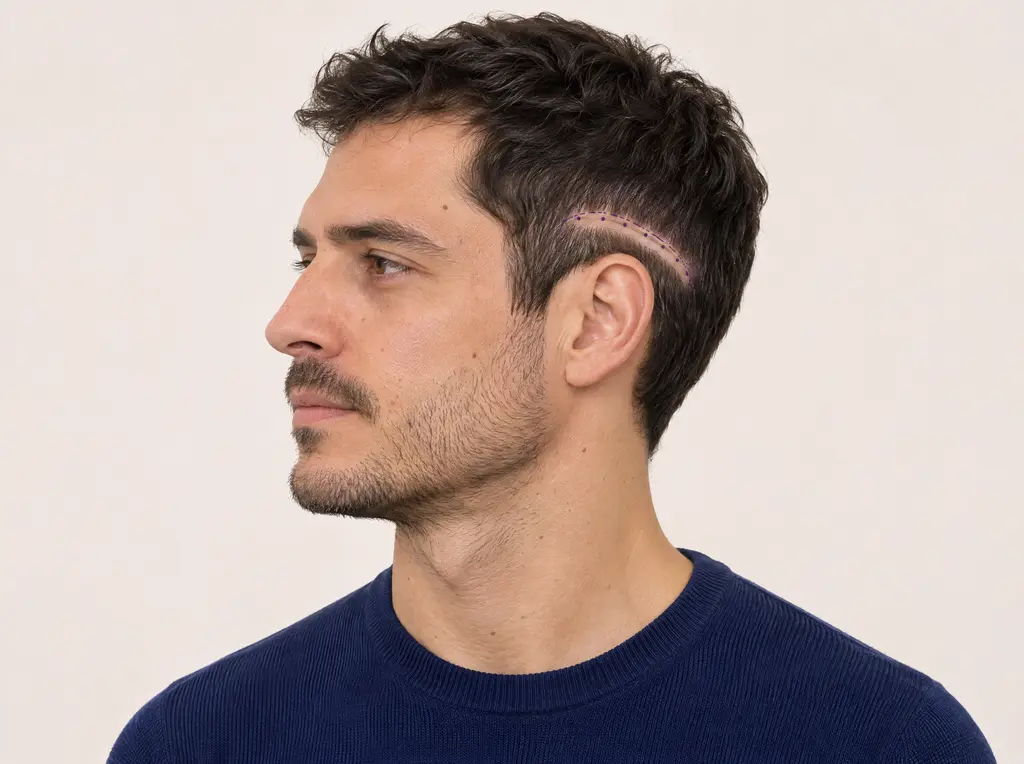
Scar Hair Transplant
Grafts into scalp and beard scars, planned around the scar's blood supply.
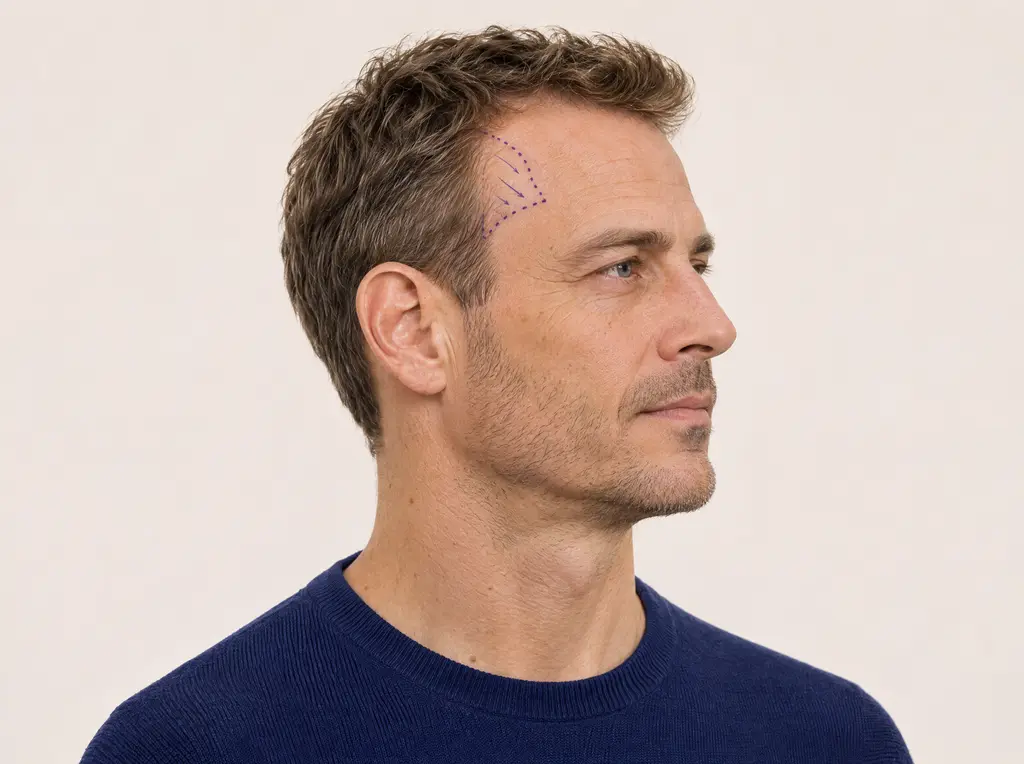
Temple Hair Transplant
A natural transition planned around the temple triangle and hair direction.
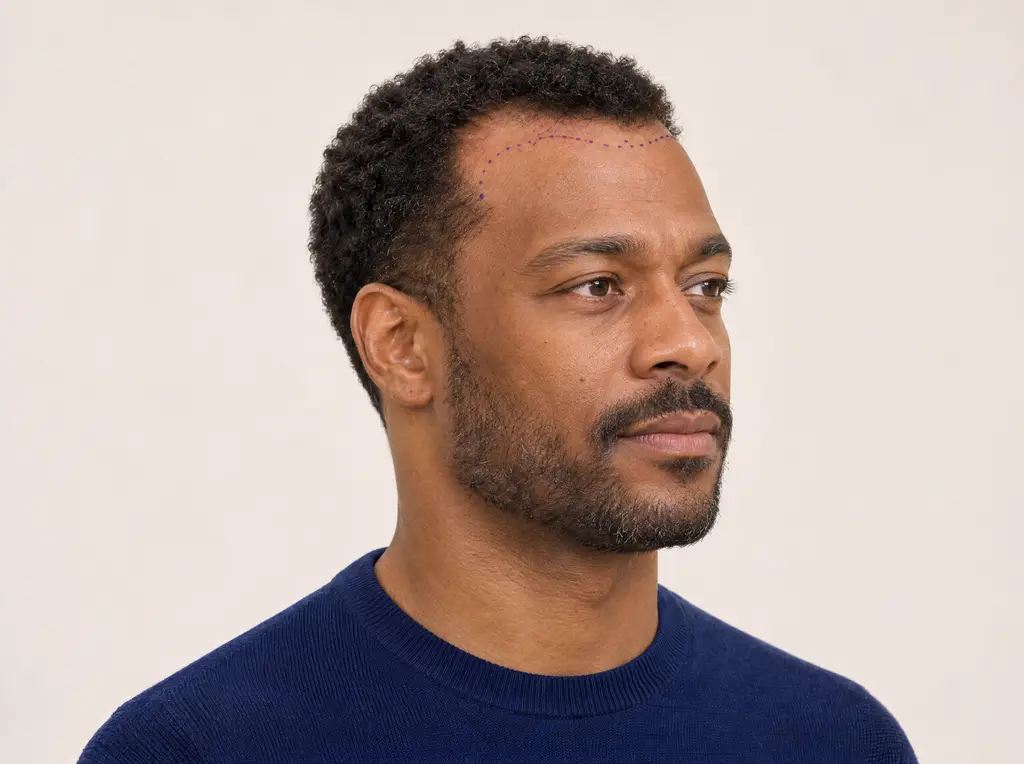
Afro Hair Transplant
Graft extraction and channel direction suited to curly hair follicles.
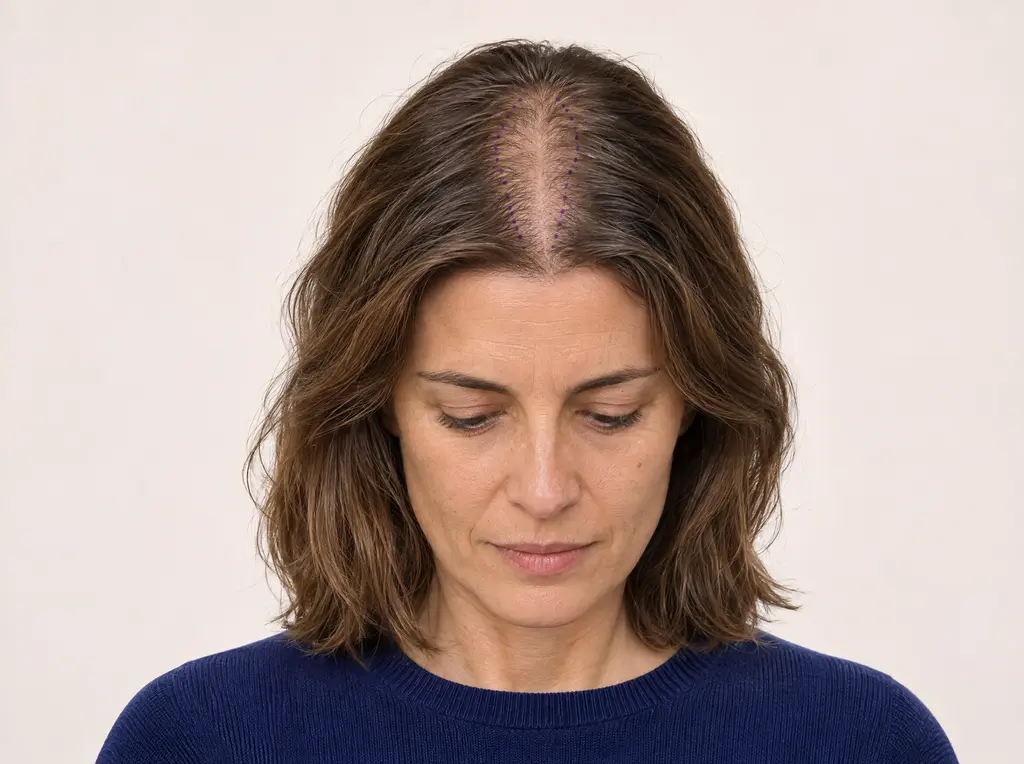
Female Hair Transplant
An examination clarifies the cause of thinning; the procedure is often planned unshaven.
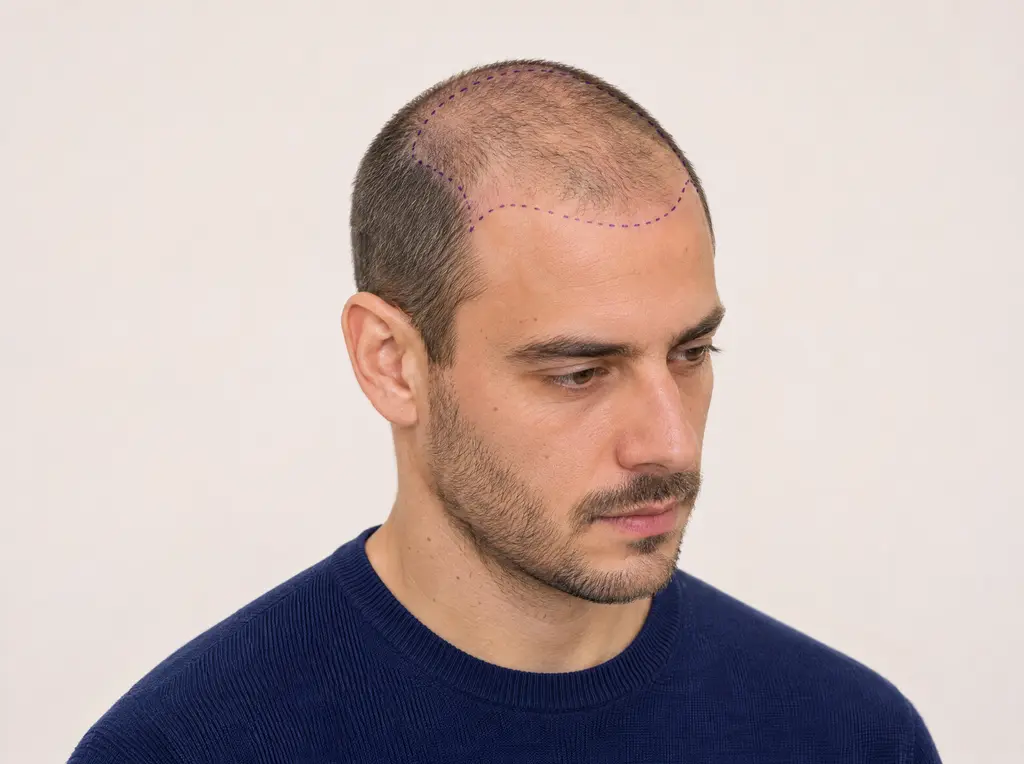
Scalp Micropigmentation
Medical pigment that gives the look of density in thinning areas.


Representative images
Surgery day
One day in five steps. Before each step, you are told what will happen. Numbing is done with local anaesthesia and you stay awake throughout. At the end of the day you return to your hotel with your aftercare kit and written instructions.

- 45 minExamination and plan
Assessment with a hair analysis device and blood tests if needed; the hairline is drawn together with the doctor.
- 20 minLocal anaesthesia
The donor and recipient areas are numbed; you stay awake throughout.
- 2–3 hoursGraft extraction
Grafts are taken one by one from the back and sides of the head and kept in a holding solution.
- 3–4 hoursOpening channels and placement
Channels are opened at the planned angle and direction; grafts are placed one by one.
- 30 minAftercare and discharge
The area is dressed; you receive an aftercare kit and written instructions.
Durations are for Sapphire FUE and vary with the technique and the number of grafts.
Frequently asked questions
Is a hair transplant painful?
The procedure is done under local anaesthesia. You may feel a brief sting while the anaesthetic is given. Throughout the procedure, your team regularly checks that you are comfortable.
How many grafts will I need?
The number of grafts depends on the size of the thinning area and on your donor area. It is set once your photos and the examination findings have been assessed.
Will the transplanted hair fall out?
Some transplanted hairs may shed in the first weeks while the roots stay under the skin. This is a normal phase (shock loss); new hair grows back from the roots around month 3.
Will my own hair keep falling out after the transplant?
A transplant does not stop hair loss itself. That is why the plan takes possible future loss into account and, if needed, supportive treatment is discussed.
How many days do I need to stay in Istanbul?
Usually 3–4 days: arrival, surgery, then a check-up and the first wash. Your patient coordinator confirms the exact length of stay in writing, based on your plan.
Who will perform my surgery?
During planning, we tell you in writing the name and registration number of the doctor who will perform your surgery, and their role in the operation.
Let's review your hair together.
Tell us about your hair in three short steps, and your hair transplant specialist will get back to you.
- 01You apply and share your photos
- 02Your hair transplant specialist reviews them
- 03Written quote