



- Category
- Planning
- Date
- Reading
- 7 min read
How is a natural hairline planned?
In a hair transplant, the hairline is what catches the eye most at first glance. Even a dense transplant may not look natural if the hairline is poorly designed.

Contents
Short answer
A natural hairline is not ruler-straight: it has a slightly irregular front edge, a soft transition zone of single-hair grafts just behind it, and density that builds towards the back. Its position is set according to your facial proportions, your age and any hair loss that may come later; a very low hairline may not look natural over the years.
- Front edge: not straight, slightly irregular
- Transition zone: single-hair grafts
- Behind it: multi-hair grafts
What makes a hairline look natural?
A natural hairline is less a single line than a gradual transition that gets denser from front to back. What separates it from an artificial-looking hairline comes down to a few points:
| Looks natural | Looks artificial | |
|---|---|---|
| Front edge | Slightly irregular, with small ins and outs | Ruler-straight or rounded |
| Grafts at the very front | Single-hair | Two or three hairs, in clumps |
| Density | Builds gradually from front to back | The same from the first row |
| Angle and direction | Low to the skin, following the hair's natural flow | Upright or in mixed directions |
| Height | Suits the face and age | Too low |
Just behind the front edge there is a transition zone about 0.5–1 cm wide. The literature recommends placing only single-hair grafts here, and the small irregularities of the edge are created with single-hair grafts too. Further back, two- and three-hair grafts build up the density. This gradual change from fine to thicker hair is what gives a hairline its soft, natural look. The recommended density in the transition zone is also relatively low, about 20–30 grafts per square centimetre. Keeping the very front this sparse is not a shortcoming; it is part of looking natural.
The angle of the hair matters at least as much as density. At the hairline, hairs emerge from the skin at a low angle, and at the temple points the angle is even lower. The angle of the channels or the pen is adjusted to match.
How is the position of the hairline decided?
There is no single measurement that suits everyone. The position is found by weighing up a few landmarks together with your own features:
- Front midpoint: the most forward point of the hairline. The literature places it 7–10 cm above the point between the eyebrows, depending on the degree of hair loss.
- Temple points: they frame the hairline on both sides.
- Facial proportions: the height of the forehead and the shape of the face influence both the position and the shape of the line.
- Pattern of hair loss and ethnic background: where the hair loss is and how advanced it is, along with your hair type, change the plan.
Why is a very low hairline not recommended?
Bringing the hairline as low as possible can be tempting if you want to look younger. The literature, however, advises against placing it too low, even when the patient asks for it. There are three reasons:
- Faces change with age. A hairline that suits you today may no longer suit your face in years to come. That is why the hairline is planned to keep suiting your face as it ages.
- Hair loss can progress. In male pattern hair loss, follicles gradually produce fewer and finer hairs. It is not possible to know in advance exactly how far the loss will go, and genetic tests cannot reliably predict it either.
- Donor hair is limited. A transplant does not create new hair; it moves hair you already have. Spending grafts at the very front leaves fewer for areas further back that may thin later.
Transplants to correct hairlines that are too low, rounded or lacking a transition zone are studied as a topic of their own in the literature. Reshaping a hairline afterwards is difficult, so a cautious first plan is the more sensible approach.
Is the female hairline different?
Yes. Most of what has been written on hairline design concerns men, and those principles do not transfer directly to women. The structures that make up a female hairline are different and need their own measurements.
A study that measured the hairlines of 360 women found that most had a small, pointed peak in the middle and gentle mounds on either side. The average distance from mid-eyebrow level to the front midpoint was 5.5 cm. Design approaches proposed for the female hairline look at five areas together: the frontal area, the recess between forehead and temple, the temple peak, the area below the temple and the sideburn.
How is a hairline planned?
- Examination: the degree of hair loss, the density of your donor area, your age and your expectations are assessed. At the clinic your scalp is examined with a hair analysis device, and blood tests are requested if needed.
- Landmarks: the front midpoint and the temple points are set to suit your face.
- Drawing: the hairline is drawn on the skin before surgery. Looking in the mirror together, you can talk through its height and the temple points.
- Implantation: single-hair grafts go at the front at a low angle to the skin, multi-hair grafts further back. The method is chosen according to the area being treated; our DHI and Sapphire FUE pages explain the differences.
The ISHRS lists hairline design among the steps of surgery that should be carried out by a licensed doctor. We suggest asking at your consultation who will draw your hairline.
To talk about how your hairline could be planned, apply for a Free Hair Analysis.
This article is for general information and does not replace diagnosis or treatment. Your doctor decides which method suits you after examining you.
Frequently asked questions
Can I choose where my hairline goes?
Your wishes are the starting point of the plan, and you discuss them together while the line is drawn. The literature, however, advises against placing the hairline too low, even if the patient asks for it. The final decision is made after assessing your facial proportions, your age and your donor area.
Which technique is used for the hairline?
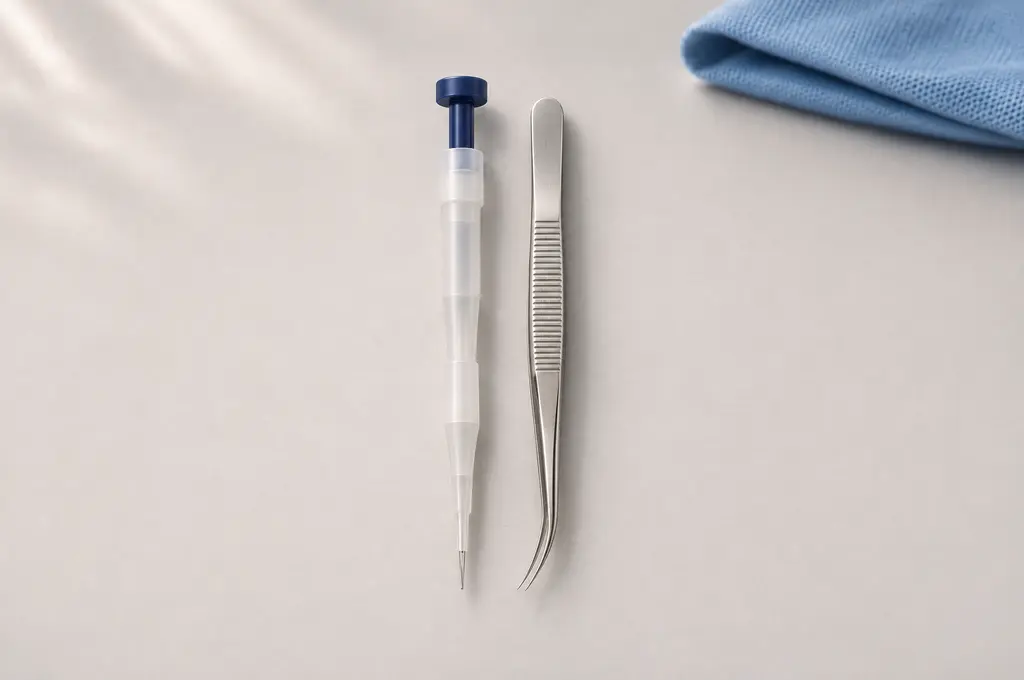
Whatever the technique, the key is placing single-hair grafts at the front at a low angle to the skin. If grafts need to go between existing hairs, placement with a pen may be preferred; in a bald area, channels can be opened instead. You can find the details in our FUE or DHI article.
Can a transplant be done on the hairline alone?
Yes, it can be planned as a limited area. If your hair loss may progress, the plan also considers how the area behind the hairline will look in future.
Should the temple recessions be filled in too?
The temple points frame the hairline. Hair there grows at an even lower angle to the skin, so the implantation angle is adjusted to match. How much to fill in depends on your face and your donor capacity.
References
- Marwah MK, Mysore V. Recipient area. J Cutan Aesthet Surg. 2018;11(4):202–210. doi.org/10.4103/JCAS.JCAS_124_18
- Gómez-Zubiaur A, Mir-Bonafé JM, Muñoz Moreno-Arrones O, et al. FUE for the repair of unnaturally designed or low hairlines in men with androgenetic alopecia: a retrospective, multicenter observational study. Front Med (Lausanne). 2026;13. doi.org/10.3389/fmed.2026.1735251
- Nusbaum BP, Fuentefria S. Naturally occurring female hairline patterns. Dermatol Surg. 2009;35(6):907–913. doi.org/10.1111/j.1524-4725.2009.01154.x
- Park JH. Novel principles and techniques to create a natural design in female hairline correction surgery. Plast Reconstr Surg Glob Open. 2015;3(12):e589. doi.org/10.1097/GOX.0000000000000548
- DermNet. Male pattern hair loss. Updated by Sinclair R; July 2015. dermnetnz.org/topics/male-pattern-hair-loss
- MedlinePlus (US National Library of Medicine). Hair transplant. Reviewed 5 February 2025. medlineplus.gov/ency/article/007205.htm
- International Society of Hair Restoration Surgery (ISHRS). Consumer advocacy. Accessed 20 October 2026. ishrs.org/patients/consumer-advocacy/
More articles



Representative image
Let's review your hair together.
Tell us about your hair in three short steps, and your hair transplant specialist will get back to you.
- 01You apply and share your photos
- 02Your hair transplant specialist reviews them
- 03Written quote